Showing posts with label Nature. Show all posts

Sunday, 9 January 2022

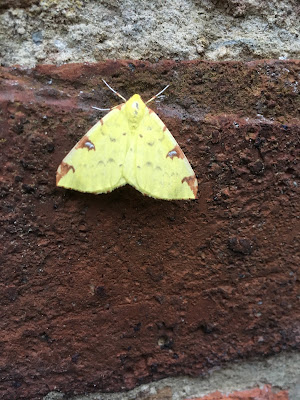
Moths of an Urban Garden #1 - The Brimstone Moth

Hi everyone. This is the first in a series of short blog posts that I'm planning to do, hopefully once a week, using photos of moths that I have taken in my garden, in urban Middlesbrough, and on nearby sites (such as Middle Marsh Nature Reserve).

For the first entry I've chosen the Brimstone Moth (Opisthograptis luteolata). Even though you quite likely have never seen, or even heard of this insect, it is very widespread and common in the British Isles being found everywhere except Shetland (in the very northern part of our archipelago).

Like many moths it mostly flies at night (unless disturbed accidentally during the daytime) but is found in hedgerows, gardens, parks and woodland where it lays its eggs on Blackthorn and Hawthorn and other shrubs, which the caterpillars will feed on after the eggs hatch.

The English name comes from an old name for the chemical element Sulphur, which is a pale yellow colour, like the moth. There is also a species of butterfly called the Brimstone, a much larger species which you may have seen flying along woodland rides in the early spring.

Although common, I have only caught Brimstone at my garden moth trap once (on the 1st of August 2021) since I started trapping there in 2018. As with all the moths I trap, this one was released unharmed when I let it go. After resting a while on my garden wall, it flew away into deeper cover where it was safe from predation by birds.

Tuesday, 6 April 2021

One rare(ish) bird, "What is an Ouzel?" and a mini-essay on grouse moor management

Spring is here but the weather is still quite wintry (with a few warm days) and a lot of the winds have been coming from the northern quarter of the compass. Possibly as a result of this, the spring migrants have been relatively thin on the ground and have taken a bit of an effort to find.

After the Wheatears that I saw on the 28th of March, the next spring migrant to be added to my NMT list for the year was Sand Martin (NMT #113 on the 31st of March), represented by a flock of at least 44 feeding on aerial insects over Portrack Marsh in Stockton-on-Tees, on one of the few warm days. Although a few birders round here have seen Swallow and House Martin (both close relatives of the Sand Martin) I have yet to connect with either.

On Saturday I went north of the Tees again, despite the fairly strong northerly wind and had a lovely day's birding around the Saltholme and Greatham Creek areas. There were lots of birds around (I saw 65 species and there were others that I missed), but as I had seen most of them on previous visits, I only added two species to the NMT list. 

The first of these is the "rare(ish) bird" mentioned in the title of this blog - a Green-winged Teal. This is the North American version of our Common (or Eurasian) Teal, which is now recognised by the International Ornithological Congress (IOC) as a separate species (they used to be considered sub-species). I say "rare(ish)" because, as with the American Wigeon that I saw in mid-March (see http://northormesbynaturalist.blogspot.com/2021/03/bike-and-boots-birding-woo-hooo-century.html) there are always a few Green-winged Teals knocking about the country, and this bird (or another one) has been visiting Saltholme every winter for at least 10 years now. It is distinguished from 'our' Teal by the vertical white bar on the sides of the breast and the absence of an obvious horizontal white line. This is visible from quite a long distance - a good thing for me as the bird  was nearly 400m away in a slight heat-haze.

The second new NMT bird for that day was the Common Sandpiper which had been eluding me every time I stopped at Billingham Beck  on the way to and from Saltholme. Most of our Common Sandpipers spend the winter around the Mediterraneam or further south but some occasionally over-winter here. Consequently, I am not sure if this bird was an early spring migrant or one that has been here since last year. 

Also of interest on Saturday were another Spoonbill at Saltholme, and a White Wagtail (this is the  more widespread version of the species that includes our Pied Wagtail - as I'm only counting full species for the NMT it doesn't count on the list). I had assumed that this was the same bird I saw at the end of February but pictures taken by better photographers than me (enabling reading of the rings) have shown that there have been at least three different Spoonbills at Saltholme so far this year.

Today (Tuesday the 6th of April) I took advantage of a day off to make what I think is my longest NMT journey so far this year (certainly the hardest, with strong northerly winds, snow showers and some very steep hills), into the North York Moors National Park.

Having made it up the whole of Ormesby Bank (10% slope in some places), non-stop for the first time, I headed to a little village with a stream running through it where I know that Dippers breed, and, ta-daah, before I'd even got off my bike I'd seen one sitting in the middle of the stream under the bridge. Dippers are Passerines (songbirds) but unlike most songbirds they spend their whole lives in or near water, and actually submerge themselves completely when searching for insect larvae and other aquatic creatures on which they feed.

There are 5 species of Dipper in the world, all very similar in size, shape,
and lifestyle, but varying in plumage a bit. The full name of our species
is White-throated Dipper and it is found in fast-flowing streams across most
of Europe and parts of central and western Asia 

When I first saw the wood and wire fence hanging down from this bridge
(a couple of weeks ago), I worried that it might put the Dippers off from breeding
here this year (I don't remember it being there on previous visits), and possibly 
even lead to the birds being injured. It doesn't seem to have done so and this
bird flewaway safely after I had watched it for a few minutes

From the Dipper site I headed up into the edge of the Moors to the outskirts of Kildale village, where I again struck lucky as soon as I arrived at my destination. My target species was a Ring Ouzel, which as well as being my second new NMT bird of the day, was also my second 'ouzel' (actually, now that I think about it, it was my third ouzel of the day - read on to see why). This brings us to the question in the title of this blog - What is an Ouzel? The Ring Ouzel is a bird in the Thrush family, very similar in size and shape to our common Blackbird, but with a large white crescent on the chest (clearest in the males) and white edges to the wing and belly feathers. It is a summer visitor to uplands in the UK and so is sometimes known by the old name 'Mountain Blackbird'. Interestingly, the previous species I talked about, the Dipper, used to be called the Water Ouzel.  The name Ouzel comes from the Old English word 'Osle', and was originally applied to the widespread Eurasian Blackbird, which is why I realised as I was writing this that I actually saw three species of Ouzel today.

The bright white chest crescent on this otherwise mostly black bird, 
marks it out as a male Ring Ouzel. This was one of three that were found
 at the weekend, but despite struggling to the top of a hill in a bitterly cold
wind I was unable to find the others [after getting home I learned that the
others were still there and have now been joined by a fourth]

Immediately after spotting the Ring Ouzel I saw and heard a Red Grouse (NMT#118). Similarly to Pied Wagtail, this is actually the British and Irish subspecies of a much more widespread species - the Willow Grouse (known as Willow Ptarmigan in North America where its range stretches from Alaska to Newfoundland, making it a good candidate, surely, for the title of most widespread game-bird in its natural range).

If you are a fan of Famous Grouse whisky you should recognise this
bird from the picture on the bottle. I took this picture in November
2018, in almost exactly the same spot as I saw today's bird


Red Grouse seen through the smoke from a controlled heather burn -
November 2018

Although Red Grouse is a wild, native bird in the UK, it is much more numerous than it would be if the moors weren't carefully managed by regular burning of the heather for the industry that is 'Driven Grouse-shooting'. Although burning encourages the young growth of heather, on which the grouse feed, when done over a whole landscape, as it is in huge areas of upland Britain, it creates a very uniform habitat and has many negative effects on moorland ecosystems. These include changes to peat hydrology, chemistry and physical properties, changes to the chemistry of water in rivers and streams, killing of trees and shrubs, the reduction of the diversity and extent of boggy areas and the consequent diminution of the whole web of moorland life, from the invertebrates to large birds. There have also been many documented instances of illegal killing of birds of prey by game-keepers on grouse-shooting estates, and despite being a National Park, the North York Moors is notorious for this. Consequently, while I was on actual heather moorland today I saw very few bird species, and no large birds of prey - there should be Common Buzzard, Hen Harrier, Short-eared Owl and Merlin but sadly they are very hard to find in much of the moors. 

Having tried and failed to see more Ring Ouzels, I retreated to a (slightly) lower altitude where I started to see more birds again - Lapwings, Curlews, Oystercatchers (all upland-breeding waders), my only Mistle Thrush of the day, and, in a small area of open deciduous woodland, I heard my first Green Woodpeckers of the year (bringing the NMT-list to 119). Unlike our other two British woodpecker species, Green Woodpecker mostly feeds on the ground (ants being its main food), although it still deserves the name woodpecker as it excavates its nest holes in tree-trunks. The call of this species is an unmistakeable loud laughing sound, which gives it its old country name of Yaffle. Readers of my generation may remember the children's TV programme Bagpuss which featured a character called Professor Yaffle - 'an old wooden bookend in the shape of a woodpecker'. Judging by his name he must have been a Green Woodpecker (although being made of wood, he was entirely brown).

I went home (into the teeth of a northerly gale) via the imposing (and visible for miles around) monument to Captain Cook near Great Ayton (read more about this, here https://en.wikipedia.org/wiki/Easby_Moor). Although I didn't add any more new species to my year-list I did hear several flocks of Siskins in the conifers, and saw my only Rook of the day as I was hurtling down the steep hill into Great Ayton.


Monday, 29 March 2021

Some more "Non-motorised Birds" - Including "Super-Bird"

 A male Northern Wheatear aka "SUPER-BIRD"  at South Gare 
(read on to find out why they deserve this title)


Hi everybody. Sorry it's been a couple of weeks since I last blogged. I wanted to wait until I had a few more birds to talk about that were new for my NMT list. Since my last post on the 15th of March I have been to South Gare (twice), done an evening visit to Ormesby Hall to look for owls, and spent quite a bit of time around the 'becks' of East Middlesbrough. In that time I have added 8 new species to my non-motorised bird list for the year, bringing it up to 112, as of yesterday.

On the 17th of March I celebrated St. Patrick's day by going in search of a bird which doesn't actually exist in Ireland - the Tawny Owl (although as St Patrick is thought to have grown up in Britain he probably saw and heard it in his childhood). I braved the wind and went out, just as it was turning dark, for a bike ride to a few likely places. I started by heading down to Grove Hill and along part of Marton West Beck, crossed the beck at Devil's Bridge and down to the old Nature's World site, where I knew Tawny Owls had been calling recently. Maybe because I was too early in the evening, or perhaps for another reason, I didn't hear any owls - I could only get to the edge of the site as it was locked up for the night, but the hoots usually carry a long way so if they were in there calling I would have expected to hear them. From there I went along Ladgate Lane, through quite a bit of woodland (Tawny Owls' favourite habitat) but still no owls. A quick diversion into the north-west corner of the grounds of Ormesby Hall (a National Trust property) also drew a blank so I decided to go round to the other side of grounds - along Ladgate Lane and up Church Lane. This is a very quiet, badly lit road (it was pitch dark by now) which leads up into the back of Ormesby village. I hadn't gone very far before I was rewarded with the distant hoot of a Tawny Owl, and then another one a bit closer (or maybe the same one). Number 105.

A few days later, on the 20th March I made the trip to South Gare for the second time this year. Thankfully it was a lovely day with none of the ice that made the last trip a little 'interesting' (or foolhardy maybe). Before getting to the Gare I made a detour/ short-cut through the Tees Valley Wildlife Trust's Coatham Marsh Reserve. Although I didn't get any new birds for the list here, it was lovely to cycle past the lakes and waterways and I saw lots of waterbirds, including a few Pochard, a singing male Reed Bunting and a couple of Little Grebes (aka Dabchicks, which I also heard making their distinctive whinnying 'song'). 

Two Pochard - the male above and the female below. Photo
taken 6th of March 2021 at Greenabella Marsh


Once I got to the Gare I didn't have far to go before I saw a couple of birders standing looking at something behind the fence around the old blast-furnace. It was #106, a Little Ringed Plover. Before the 1930's this migratory wader (which was in Africa a few weeks ago having spent the winter there) was a rare vagrant to Britain. Around that time there was an increase in the number of old gravel pits and quarries that were being flooded to create small lakes. These, as well as other man-made reservoirs, had many gravelly shores and islands, which made excellent breeding habitat for the Little Ringed Plover. It quickly spread, after successfully nesting here for the first time in 1938. It now nests at many sites across England and Wales, with maybe as many as 1,300 pairs. Like the much commoner Common Ringed Plover it is a stocky little bird which is light brown above, and white below, with a black neck collar. Unlike its cousin though, the LRP (as birders call them) has dull pinkish (not orange) legs, no orange on the bill, and,  in breeding adults, a distinctive yellow ring around each eye.

Having had a good long look at the LRP I went on to the end of the Gare - stopping briefly to look at some Redshanks, Oystercatchers and Curlew on Bran Sands on the way. I later heard that I had just missed a couple of Avocets on the beach - they were flushed by a dog just before I got there. From the very tip of the Gare I managed to pick out a distant Guillemot (Common Murre to any readers in North America), still in its winter plumage. This was NMT bird number 107 and was closely followed by #108, a Rock Pipit (appropriately on the rocks) and #109, a Stonechat, in the bushes and long grass at the end of the road. While watching the Stonechat I could hear a Skylark singing his heart out above me and also managed to get this nice picture of a lovely male Common Eider just offshore.

From South Gare I went along the coast to Redcar Beach, where I was hoping to add Common Ringed Plover to the year list, but no luck, although I did count around 200 Sanderling, over 100 Turnstones and 4 Purple Sandpipers, among the hundreds of dog walkers and other people enjoying the nice weather

On the 24th of March, while actually at work (showing my colleague Caspar around the new Nature Reserve in North Ormesby), Caspar, pointed to something inside an abandoned shopping trolley that had been dumped in Ormesby Beck. It was a Water Rail (NMT #110), thankfully not trapped in the trolley. It scuttled away into the reeds, quickly followed by a second one which came from a different direction. These are the first that I've actually seen on my local patch, although another birder messaged me a week before this to say that he'd seen and heard one in the exact same spot.

The last two NMT 'ticks' (tick=a new bird for a list), were both seen yesterday. The first of these, Common Ringed Plover (at last), was represented by three birds apparently displaying to each other at a potential breeding site about a mile and a half from my house. Last year I saw one at the same site that seemed to be guarding a nest, although I never proved breeding success. I am planning several visits there later in the season to see if I they nest again (although it's rough ground, they are small brownish birds, and the closest possible viewpoint is 100 metres away, so it might still be hard to prove if they do). 

It was still early in the day when I'd finished looking at all the best birding spots within easy reach of my house, so I carried on along the Teesdale Way to Coatham Marsh and South Gare. I had a little walk around the 'slag plateaux' in the middle of the Gare, looking for Wheatears and other migrants but it was extremely windy by this time and I saw very few birds in this exposed area. Not wanting to lengthen the already long ride home against the wind, I decided to turn around at this point instead of going to the end of the Gare, but kept checking every bit of flat open ground as I went, as these are the places where Wheatears are often seen during the migration periods. 

This diligence paid off and I got lovely views of two male Northern Wheatears (known as just 'Wheatear' to British birders as it's the only one we get usually) and was even able to get some pictures of one of them -  number 112 for my NMT year-list. This small bird in the Chat Family (a bit bigger than a European Robin) is often one of the first migrant songbirds that birders see in the spring, after they (the birds, not the birders) have made the journey from their wintering grounds in sub-Saharan Africa. 

If this seems like a long way for a small bird to migrate, the British-breeding birds have got nothing on the two populations of the species that breed in North America. The ones that nest in eastern Canada fly, in autumn, through Greenland, Iceland and then across mainland Europe and the Sahara Desert, And back again in spring. However, the western population, which nests in Alaska and the Yukon Territory of Canada, is now thought to have the longest migration route of any passerine (songbird) species. 

Recent studies, using electronic tracking devices, showed that some of the Alaskan birds travelled around 15,000 km (over 9,000 miles) in spring and again in autumn. As some birds breed further east in the Yukon it seems likely that these ones have an even longer journey (although it is possible that they winter further north in Africa). 

The tracked birds travelled on average 290km per day. Long-distance cyclist Mark Beamont apparently averaged 390km a day during his amazing "Around the World in 80 Days" feat in 2017 (https://en.wikipedia.org/wiki/Mark_Beaumont_(cyclist) - he actually did it in under 79 days) , but he was a 6 foot 3 inch adult human, weighing about 90 kilos, and moreover, he had a support team following him with food, drinks and medical assistance. The Wheatear weighs about the same as 5 teaspoons of sugar (25 grams) and has to do it without any support team. In the case of young birds in the autumn they have to navigate completely by instinct, having never done the journey before, and if that isn't hard enough, (and in common with most passerine migrants) they do it mostly at night!!! Truly a SUPER-BIRD

Northern Wheatear (male) at South Gare. The name has nothing to do with
cereal crops and in fact comes from the Anglo-Saxon for "White-Arse"
referring to the big white patch on the rump and tail, which is often all
you see as the bird flies away. 


Monday, 15 March 2021

Bike and Boots Birding - woo hooo! The century has been reached and exceeded

Rather than describe every detail of my birding over the weekend I will just list the new NMT (Non-Motorised Transport year list, for those of you that are coming late to this blog) birds and say something about each of them, and then maybe mention a few other birds I saw.

#99 - Red-legged Partridge at Smith's Dock, South Bank, Redcar & Cleveland, on Saturday the 13th of March. This was at the very furthest point of my walk on Saturday (actually beyond the furthest point), scuttling out of sight up the bank of the River Tees. Quick view but long enough to see all the distinguishing features -  black necklace on an otherwise mostly grey and beige  bird with a roundish compact body and protruding head. This is the partridge that is often depicted on Christmas cards illustrating the song "The Twelve Days of Christmas". However, this bird was unknown in Britain before the 1700s, when it was brought over from its native range in mainland Europe (for which reason it used to be known as the French Partridge).

#100 (Way-hay, Party tiiiimmeee 😃😃😃) - American Wigeon on Port Clarence Flood (part of the Saltholme complex of pools). This was a proper twitch for a pretty rare bird (although I combined it with  normal birding in the area) - this bird has been hanging out with some of the hundreds of Eurasian Wigeon in the North Tees Marshes for the last week or so. As its name suggests, the American Wigeon is more usually found on the other side of the Atlantic where it is a very common bird across most of North America. In the UK, although it is rare, there are always a few scattered around the country for most of any given winter but the chances of one being within easy cycling distance of my house is fairly small so I'm very pleased with this addition to my year-list. Sadly it was too distant to get a photo of. It's similar in size, shape and behaviour to its commoner relative but the male (of which this was one) is easy to tell apart by its white forehead (giving it the colloquial name of 'Baldpate' in its home range)  and green band through the eye. Thanks very much to the birder who found the bird and showed it to me - I don't know your name but I am very grateful.

#101 - Whooper Swan on Dorman's Pool. I thought I'd missed my chance for an easy Whooper Swan for the year and would have to rely on the possibilty of catching a migrating flock in flight (and I have to admit I'm still not very confident at identifying them in flight). Thankfully a few days ago this one showed up at Dorman's Pool and lingered until yesterday (it seems to have gone now so I was lucky). Unlike our resident Mute Swans (but like the smaller Bewick's Swan), this species only comes here in the winter and spends the summer much further north (mostly Iceland in the case of Whoopers). 

An adult Whooper Swan at Dorman's Pool, 14th March 2021. The bill is
distinctly different from that of Mute Swan (see the picture a Mute, below). The
neck is often held straight (again, unlike a Mute) but this one was feeding very
actively in one spot, putting its neck below the surface of the water, and I
caught it halfway up (or down)


#102 - Marsh Harrier (at last) - flew over the road as I was cycling along. For the last few weeks I kept dipping on Marsh Harriers (birder-speak for not seeing something) in my trips north of the Tees - other people kept seeing them (on one occasion one flew over my head but I knew nothing about it until someone showed me the picture on his camera (at a safe distance of course)). This is a beautiful bird of prey, similar in size to a Common Buzzard but longer-winged, more slender, and definitely more graceful. Like the Avocets that I wrote about a couple of weeks ago (as well as in this article https://thetees.online/avocets-return-to-the-tees/), the Marsh Harrier probably went extinct as a breeding bird in the UK in the late 19th Century, and also like Avocet has had a great turnaround in its fortunes, with an estimated 400 pairs breeding here now at scattered locations around England, Scotland and Wales.  I didn't get a photo of it but hopefully will have another chance at some point - if I do I'll share it in a future blog.

#103 - Yellowhammer at Cowpen Bewley Woodland Park. This is one those birds that visiting birders to the UK from North America often want to see, just because of its name. It is similar in size and shape to a House Sparrow, although not very closely related (Yellowhammers are buntings) and they look very different. The breeding males have bright yellow heads and bellies, with streaky brown, black and rusty red plumage on the rest of the bird. Females, and males in winter, are much more streaky with the yellow being less obvious. The one I saw on Sunday was a very bright male but he was skulking at the bottom of a bush under a very impressive array of bird-feeders. He didn't linger long enough for me to get a photo, so I've used some that my friend Rich Prior took at his home in France, where he get large numbers at his feeders - these show nicely how much the amount of yellow can vary. The first one is (I think) an adult winter-plumage male, while the second (with hardly any yellow, looks to me like a female in its first year (I may be wrong though). The third picture shows a mixture of the sexes and ages.


 ⓒ Rich Prior

 ⓒ Rich Prior

 ⓒ Rich Prior

As well as the Yellowhammer the feeders had attracted several other species, including Great, Blue, Coal and Long-tailed Tits (Marsh Tits are sometimes seen there but sadly not by me on this occasion), a few Chaffinches, a lovely male Bullfinch and at least 27 Tree Sparrows - the largest number of this species that I have seen in one place in the UK for at least 30 years (possibly ever).

Four of the 27 (maybe more) Eurasian Tree Sparrows that were at Cowpen Bewley
Woodland Park on Sunday

I don't use the word 'cute' very often, but I have to admit that Long-tailed Tits are 
extremely cute. They often travel around in large groups, especially in the autumn
and winter, making their little 'drrr, drrr' calls to each other fairly constantly

While I was sitting watching the bird-feeders at Cowpen Bewley, I spotted something out of the corner of my eye - a dark shape in the sky which turned out to be my last new NMT-bird of the day. It was...

#104 - Common Buzzard. As with the Marsh Harrier, I have missed seeing this common raptor (a bird of prey NOT a dinosaur) several times recently when I thought I was going to. The name Buzzard can lead to confusion for birders from other countries - in North America, birds in the genus Buteo (as Common Buzzard is) are just called Hawks and buzzard is an old word for what are now called New-World Vultures, such as the Turkey Vulture. To add to the confusion 'Busard' is the French word for Harriers, while the word for members of the genus Buteo is 'Buse' (presumably 'Buses' is the plural, which might explain why you often see several together having not seen any for ages). On this occasion, however, there was only one.

All photos  ⓒ Colin Conroy unless otherwise stated.

Friday, 12 March 2021

Avocets, Thrushes, Snow Buntings and a winter flower - four articles I have written recently

It's been a while since I've shared the links for my posts on The Tees Online (https://thetees.online/) - the local website that I write articles (well, blogs basically) on once a month. Below are the links for the last four (including one that went live today), plus a few of the photos to give you a taster before you click.

https://thetees.online/avocets-return-to-the-tees/

Close-up of an Avocet - photo by Dave Barlow


Fieldfare on the hunt for worms (probably) at Cowpen Marsh
- photo by Colin Conroy


Common Whitlowgrass flowers - photo by Kevin Widdowson

https://thetees.online/spotting-the-elusive-snow-bunting-at-south-gare/

Snow Buntings at South Gare - photo by Colin Conroy


Saturday, 6 March 2021

Three more NMT birds on a cycle ride to Seaton Common and North Gare

This will probably be a shorter than usual blog-post today as I saw many of the same birds as last week, in the same places (Saltholme area, Greatham Creek and Seal Sands). However,  I went a bit further this time and did a loop down the Zinc Works Road, along the beach to the North Gare pier and back through the middle of the lovely, desolate area of wetland and grassland that is Seaton Common, on the road from North Gare car park. 

As I cycled along, despite the overcast and fairly cold weather, I heard lots of birds singing - Robins, Dunnocks, Wrens, Greenfinches, Chaffinches and, as I got closer to Seaton Common, several Skylarks. I was looking out for large birds of prey, particularly as I rode past Saltholme and Cowpen Marsh, as I still haven't seen Marsh Harrier or Common Buzzard this year, and both of these are being reported regularly in this area at the moment. However, I managed to miss them both again today and the only birds of prey I saw were two Kestrels and a disappearing shape that was probably a Sparrowhawk.

I stopped briefly next to the Fire Station just past Saltholme because I had heard the sharp 'chack' call of a Great Spotted Woodpecker. I found the bird easily two-thirds of the way up one of the few trees, but it flew off after a few seconds and I carried on.

Arriving at the bottom of the Zinc Works Road (just next to Hartlepool Power Station) I soon spotted two photographers with massive lenses, who I rightly guessed were looking at one of my target species for the trip. Keeping my distance from the photographers and the hoards of dog walkers, I was able to get some of my best ever (and certainly easiest) views of Twite (NMT #96). A flock of up to 50 of these small finches (very like the much commoner Linnet) was feeding on a small path (I think the photographers must have been putting down seed for them to eat, so as to make it easier to get photographs). Consequently I was able to get a few reasonably good pictures (see the bottom of this post). 

Moving on - there was very little in the way of avian life on the beach and on the sea (lots of human life though). Seaton Common however was full of birds, although mostly of a small number of species - 100s of Eurasian Wigeon (there were probably a couple of thousand in the whole area I passed through today), a few hundred Curlew in several flocks and Lapwings almost everywhere.

On the way home I saw two more new species for the NMT list - #97 Lesser Black-backed Gull, and #98 Green Sandpiper. Lesser Black-backed Gull is a very common gull in the UK but is actually quite a scarce bird in Teesside in the winter so it was good to see a few fairly distant ones on Dorman's Pool, just east of Saltholme. Green Sandpiper is a pretty little wader - nearly black above, with a contrasting white rump which shows up clearly when the bird flies. I saw one on the low-tide mud at the edge of Billingham Beck just before it flows into the River Tees.

I had been hoping to reach the magic 100 today but sadly it was not to be. However, I was really glad to catch up with Twite before they disappear off to breed, mostly to the north of here (although some do breed in the Pennines and in North Wales.

Some of about 35 Twite that I counted (although up to 50 have been seen here
in the last few days). The bird at the top  is a male Reed Bunting that I decided
not to crop out of the picture

Twite look quite similar to their close relative, the Common Linnet. That species, 
however, never have the pinky buff face of a Twite, or the yellow bill (although 
Twites only have this in autumn and winter - it's dark grey in the breeding season).
This one appears to have a pinkish rump (the area just above the
tail), meaning that it should be a male (at least according to the books).
The colour-rings on this bird (which I didn't notice until I started writing this
post), were put there by ringers to make it possible to identify individual birds
without them having to be caught. 


Monday, 1 March 2021

Cycle ride to Saltholme and Seal Sands again

Yesterday my officially permitted lockdown exercise took me north of the Tees on my bike again.

It was exactly two weeks since I last went to Saltholme and Seal Sands and it could not have been a more different day - last time it was frrrrrreezing, with snow on the ground everywhere, only small areas of open water and strong winds in my face for much of the time.

This time it was sunny and warm (except at the very start of the day), with only a light breeze, and once I left Port Clarence and started heading north along Seaton Carew Road there were birds EVERYWHERE!

I spent most of my time looking at all the different bodies of water that are visible from the road around Saltholme itself. At the first stop, in the space of a few minutes I added Pintail, Black-tailed Godwit, Goldeneye, Pink-footed Goose and Avocet to the NMT year-list. Avocets are delicate, long-legged, black-and-white waders, with amazing upturned beaks, and I was quite excited about them as I hadn't realised they returned to Saltholme this early in the year (it turns out that they regularly show up in late February). While I was watching the Avocets, on the area known as 'Port Clarence Flood', I spotted a large white bird wading in the water. I quickly realised that it was too big to be a Little Egret and not the right shape for a Great Egret (one of which had been reported from the area yesterday). When it lifted its head I was able to get a good view of the bizarre protruberance that is a Spoonbill's bill. These are not unknown in the Saltholme area but I hadn't heard of any since last autumn so I was really pleased to find it. It was very distant but the bird later moved to a different pool where I got some photos of it.

Eurasian Spoonbill - hiding its bill but showing its distinctive horizontal
resting posture which, along with its crazy 'hairstyle' distinguishes it from
a resting Great Egret. Just visible on this photo are the leg rings that this
bird was sporting - put there by scientists in either the Netherlands or
Belgium apparently

Unfortunately I cut off the bottom of the bird in this pic but did manage
to capture the amazing spoon-shaped bill

After finding my first Little Egret for the year, I moved on to Saltholme East Pool. I quickly found more Little Egrets and a Great Egret (exactly where another birder had told me it was). It was really nice to see these two right next to each other - showing very clearly how much bigger the Great Egret is, as well as the different bill colours (black in Little Egret, yellow in Great). At this point I should say something about the name of the latter. Most British birders call this species 'Great White Egret' but the internationally accepted name is Great Egret, and as nearly all egrets are white I am using this name here. 

Great Egret showing its yellow bill, and giving a good size comparison
with a Mallard (which is roughly a similar size to a Little Egret)

A cropped shot of a distant Little Egret,
showing the black bill and yellow feet

Great and Little Egrets together - the best shot I could get showing
the size difference

Saltholme East also held many ducks including more Goldeneye, lots of Tufted Ducks and at least three male Pochard. This last was another new bird for the NMT list, as was Great Crested Grebe (not a duck although superficially a bit like one).

A male Common Goldeneye. This beautiful little diving duck breeds in northern forest lakes and
rivers in a wide band across nearly the whole northern hemisphere. A small number breed in the
north of Scotland where they use specially provided nest-boxes, placed in trees to mimic the natural
cavities that they use elsewhere in their range

Now widespread in the UK, the Great Crested Grebe (in the foreground in this picture
- the bird behind is a tufted duck) nearly went extinct in Britain in the 19th century because
of a somewhat surprising fashion  -  their breast skin, complete with the soft white
feathers, were used as a fur substitute (known as 'Grebe Fur') in ladies' couture.
This was one of the things that led to the establishment of the RSPB. 

After Saltholme I carried on north to Greatham Creek and Seal Sands, stopping briefly at Cowpen Marsh on the way to look at a small group of White-fronted Geese that were feeding in a field with several Greylag Geese (descendants of escaped domestic birds). White-fronts (as we call them) are largely grey-brown but have black bars on the belly and a band of white at the base of the bill (from which they get their name). There are two sub-species that come to Britain and Ireland - one from Greenland and the other from Arctic Russia. These were Russian ones, with smallish, pink bills (Greenland White-fronts have longer, orange bills and spend the winter in western Scotland and Ireland).

The pools and mud in front of the view-screens at Greatham Creek had a good number of common gulls, ducks and waders on them (including about 30 Knots), although nothing new for my year-list. The vast mudflats of Seal Sands held, along with another 7 Avocets and some Shelducks, a few distant Bar-tailed Godwits. On the way back up to the road, before heading home, I took another look at some Redshanks in one of the pools next to the track and spotted  one that was much whiter looking, with a longer bill and behaving slightly differently - a Spotted Redshank! My thirteenth and last new species of the day and number 95 for the NMT year-list.


Tuesday, 23 February 2021

The first day of Spring (well, maybe) and a bit about Female Birdsong

On Sunday I cycled out to Guisborough Forest - a Forestry England site about 8 and a half kilometres south-east of my house as the Crow (or indeed the Jackdaw, Rook or Raven) flies. This involved riding up the vicious hill called Ormesby Bank (erm, well to be honest I pushed the bike up at least half of it) and then going along the fairly busy A171 Whitby Road which was a bit hairy in places  (although there is now an off-road cycle track for about half of the stretch I was on). 

The distinctive shape of Roseberry Topping, a sandstone outcrop
south of Middlesbrough, was visible for most of my journey

However, despite these hardships, I really enjoyed the journey. It felt like the first day of spring - warm and sunny with lots of birds singing. Almost as soon as I left the house I started hearing Robins, Dunnocks and Blue Tits warbling and chattering away. Then, while having a rest halfway up Ormesby Bank, I heard the descending wheeeze  that is Greenfinch song, followed by the "fast bowler's run-up and delivery" of a male Chaffinch and the repetitive teacher, teacher, teacher of a Great Tit. Just past the Cross Keys Inn on the A171 the ethereal song of a Skylark drifted down from the heavens - amazingly still audible over the pretty constant traffic noise. I didn't hear my first Blackbirds and Wrens of the day until turning off the main road just  before I arrived at the car park and visitor centre, where I locked up my bike.

The area around the visitor centre was very crowded with people, and quite noisy, so at the earliest opportunity I got on to the little footpaths going uphill and once again I was surrounded by singing birds. As well as more Robins, Chaffinches, and Dunnocks there were a couple of Song Thrushes (each lovely flutey phrase repeated two or three times before moving onto the next one) and lots of Coal Tits, particularly in the areas dominated by coniferous trees. Coal Tit song sounds (to me anyway) very like a Great Tit but more slurred and not as ringing. 

Although some of the bird noises described above might not seem very musical to you, they all qualify as birdsong and are used by the singers to attract mates, establish territories and ward off rivals. Like many birdwatchers I grew up thinking that singing birds were always, or nearly always, males of the species. In recent years however, work by ornithologists from across the world, (aided by a larger group of citizen-scientists sending in recordings) has shown that, far from being a rare event, it is actually quite common for female birds to sing, particularly in the tropics. This might be one of the reasons why it has taken us so long to notice female birdsong. 

Until the early 21st Century, most research into birdsong had been done in temperate regions of the northern hemisphere. In these places the harsh winters mean that songbirds breed only in the spring and summer, and so have to set up breeding territories every year. In addition many species are migrants that race north in the spring to their breeding areas, having spent the winter in the tropics. The males often arrive first and compete with each other to set up territories - which they do by singing their hearts out. The females then arrive and choose the male with the most elaborate song (which, presumably, indicates that he has been able to find a good territory, fend off other males while still having time and energy to waste on singing). This leads, over successive generations, to male song becoming more and more elaborate.

In the tropics it's a different story. Many species breed year round, with no discernible breeding season, and may keep the same mate and territory for several years. In these circumstances it is possible that birds sing for different reasons than in temperate or arctic zones, and that this might explain why the ladies, in some cases at least, sing much as the chaps. To find out more about this fascinating aspect of bird behaviour, or if you are just confused by my explanation, visit the Female Birdsong Project's website (The Female Birdsong Project) to find out more. You can even contribute to the project, if you see a female bird singing.

Although I didn't notice any females singing at Guisborough on Sunday, I did have an experience with this in August last year when I saw two Linnets, a male and a female, singing together for several minutes near my home - I wrote about this in my blog at the time (Linnet pair singing together). That blog post includes a bit of video in which you can hear the song, although the birds are just dots in the film. I do remember that when I was watching them through my binoculars I could definitely see that both birds were singing and not just the male.

Anyway, back to Sunday's trip. As well as all the birdsong, plus a Great-spotted Woodpecker drumming (its equivalent of a song), I saw and heard two or three small twittering flocks of Siskins at the tops of some tall alders. I searched in vain for Redpolls (another small finch about the same size as a Siskin) but did add three species to my NMT list for the year - Rook, Treecreeper and Goldcrest (nos. 80, 81 & 82) - all common species that I was surprised not to have seen yet. 

I also saw several flocks of Common Gulls in the fields next to the road - a sure sign that spring isn't quite here yet, as this species is only a winter visitor in these parts. In the next few weeks they will be dispersing to their nesting areas, mostly north of here.  

Common Gull often goes unnoticed among flocks of its noisier, better known,
cousins, Black-headed and Herring Gulls. It is midway in size between the
two and, unlike either of those species has greeny-yellow legs, feet and bill. 


Tuesday, 16 February 2021

Saltholme, Greatham Creek, Bellingham Beck and a couple of surprises at home afterwards

After nearly two weeks without any birding I was able to get out for a bike ride on Saturday. I hadn't been north of the Tees yet this year so I took advantage of the clear weather (although very cold and fairly windy) that was forecast, and headed across the Newport Bridge and along Haverton Hill Road towards Saltholme RSPB Reserve.

A few gulls on the river as I went over the bridge, and a Long-tailed Tit in the bushes just after it, were the first birds of the trip, but I didn't stop until I got to the village of Port Clarence. A flock of thrushes on both sides of the road there were enough incentive to stop (plus I needed a rest) as I still hadn't seen Fieldfare yet this year. However they were all Redwings.

After turning onto the Seaton Carew Road I started seeing a lot more birds - 4 Common Snipe that flew off one of the few unfrozen puddles at the side of the road were the first of many (at least 30 I think) that I saw during the day. A few metres further on a harsh, loud, chattering call got my attention and I saw my first Fieldfare of the year, and the first new NMT bird of the day (#69). The Fieldfare is a large thrush (a bit smaller than a Mistle Thrush but larger than Redwing and Song Thrush) that breeds in northern and central Europe  and comes to these shores in the winter. I think it is the most beautiful of our thrushes - it is certainly the most colourful, with its grey head, chestnut brown back, orangey front (with black spots), white belly and black tail. Unlike many thrushes they often nest in small colonies where they can be quite feisty when threatened by a predator - I watched a nature documentary years ago (David Attenborough I think) that showed a group of them attacking a young Raven which strayed too near the colony. Instead of just shouting at it, as many birds do, they dive bombed it with their droppings until its feathers were so gummed up that it couldn't fly.

This Fieldfare was one of many that I saw later in the day - 
posing nicely for photos on the new banks at the sides of
Cowpen Marsh and Greatham Creek


Moving on, I got to the open water of Saltholme, on both sides of the road. Or rather, what is usually open water. After the freezing weather of the previous week it was nearly all ice, with only small patches in the middle that were unfrozen. In these patches lots of wildfowl were gathered - mostly fairly distant Canada Geese on the West Pool, but a mixed group of ducks and Coot on the East Pool. 

By the time I left this area to take a detour to Dorman's Pool I had increased my NMT list to 73 - having added (as well as the Fieldfare), Coot, Lapwing (about 140 on the field next to Saltholme East), Wigeon and Shoveler.

A view across a frozen landscape toward the new(ish) Saltholme Pools hide


Eurasian Wigeon, Tufted Ducks and Mallard - there were also several
Shoveler and Coot here, but I didn't get any pictures of them

A cropped version of the previous pic showing that some of the Mallards and
Wigeon were standing on the ice. There's only one Mallard (a male) in this
picture btw. All the other birds are Wigeon - the males with red-and-buff heads,
the females plainer brown - all with bluish beaks

Dorman's Pool was in a similar state to those at Saltholme - mostly frozen with a little bit of open water in the middle, although the birds were different. A knot of about 7 swans sitting directly on the ice (apparently) teased me by keeping their heads tucked under wings most of the time but the few that looked up were definitely Mute Swans and they all seemed the same size and shape so my hope of adding Whooper Swan to the list was thwarted. Several Snipe flew out out of the long grass next to the car park, but one heavier bird proved to be a Woodcock, my second of the year. Dorman's is the best place in the area to see the elusive Bearded Tit but they were staying out of sight in the reeds on this occasion.

Next was a quick visit to the Saltholme car park and visitor centre where I added Tree Sparrow to the list for the day and the year (NMT #74). This much scarcer relative of the House Sparrow can be distinguished from its cousin by the all-chestnut crown and the black 'comma' mark on the cheek. Unlike House Sparrows, both sexes look the same in Tree Sparrows, so if you see a plain brown, sparrow in the UK, it's a female House Sparrow.
Saltholme RSPB reserve has a good population of Tree Sparrows
which are now rare in most of the UK (the UK population decreased
by 93% between 1973 and 2008)

The last leg of my outward journey took me a mile and a half further north to Cowpen Marsh, Greatham Creek and Seal Sands, where the network of pools, channels and tidal mud held good numbers of ducks and waders, including three species that I hadn't seen yet this year - Shelduck (#75), Teal (#76) and Dunlin (#77). A Marsh Harrier had been seen just before I got there but I missed it.

Then it was the long haul home, against the wind for most of the way, with just a brief stop to look at Billingham Beck, where it passes under Haverton Hill Road. I hadn't realised what a good spot this is for birds - today there were several Teal, some gulls, a Redshank and a Snipe, but (I thought) nothing particularly special. The site definitely warranted future visits though.

Arriving home, tired and happy, I was enjoying a nice cup of tea with my wife when she spotted something at the window which turned out to be a Chiff-chaff (my first of the year - #78, and the first we've ever seen in our garden)  hovering briefly before going to sit on our washing line and then taking cover in our ornamental shrubs.

I thought the Chiff-chaff was going to be the last bit of excitement of the day - until I copied the day's photos onto the computer. After picking some nice shots of Fieldfare, Tree Sparrow and other birds to put in this blog I looked at one of the not very good pics of the Snipe I saw at Billingham Beck and noticed something I hadn't even realised was there. I wanted to be sure I wasn't making a silly mistake so I sent the photo to  a friend and also sought some opinions on Twitter. They all confirmed what I thought. The little brown bird circled in red in the photo below (the Common Snipe is circled in blue) was indeed a Jack Snipe. Jack Snipe is the smallest snipe and different enough from the others to be placed in a genus of its own. It breeds in a vast range stretching from eastern Siberia to Scandinavia but in the UK is only seen in winter, where you are most likely to see it burst from almost under your feet in marshy fields, before flying a very short distance into cover again.  I had a slight dilemma about whether to count it on my NMT list or not - I hadn't, after all, seen it in the field. In the end I decided to count it, making it #78 on the list and pushing Chiff-chaff down to #79. A very nice end to a brilliant day!


Sunday, 31 January 2021

The Big Garden Birdwatch

This morning I took part, for my fourth year (I think), in the Royal Society for the Protection of Birds (RSPB)'s annual Big Garden Bird Watch. This is a 'citizen science' event which the RSPB has been running since 1978, although it was quite a small thing until 2001. That was the year that it really started to grow in popularity - 50,000 people took part after it was opened up to non-members. Since then it's continued to grow and last year half a million people counted almost 8 million birds. Yes you read that right - HALF A MILLION PEOPLE!!!

To take part in the BGBW all you have to do is register for the count on the RSBP's website (it's free) and then count the birds in your garden for one hour at some point during the last weekend in January. The last stage is to send the figures in to the RSPB via the link on the website (you can do it by post as well). You don't need to be an expert birder - there are lots of resources available on the website to help you identify the common birds in your garden, so even if you can only identify Blue Tits, Blackbirds and House Sparrows it's worth taking part. It'll have to be next year though as today was the last day of this years BGBW (although there's still a few hours of daylight left as I write so you might still be able to get in if I can get this blog written really quickly).

I wasn't very optimistic for this year's count as we've hardly had any birds at our feeders so far this winter. However, from what I can see of my data in previous years (I can't find any notes from 2019 and I can't remember if I actually did it that year or not) this has actually been the BEST YEAR EVER for my garden in urban Middlesbrough.

I was still in my dressing gown, sitting in my bedroom window from 8.26am to 9.26am and from the first minute there was no point when there weren't some birds visible in the garden. The feeders themselves were a bit disappointing, with only two Blue Tits and one Robin coming to the hanging feeders.  What really attracted the birds however were the two piles of mixed food that I had put out - one on the ground and one on an old concrete coal bunker. 

The first bird I saw was a male Blackbird on the coal bunker and he came back several times during the hour. He was joined at various points by two Dunnocks, five House Sparrows, at least three Woodpigeons and two Collared Doves. A Magpie in the tree next door, two Feral Pigeons and two Starlings on our roof and a Herring Gull on the roof of a house across the alley also count (according to my understanding of the rules anyway) but the flock of five Goldfinches that flew over don't, as you're not supposed to include birds that are only seen in flight. That brings the species count to 11. My previous record was 5, so even if you take out the Magpie and the Herring Gull that weren't actually in our garden it still beats that into a cocked hat.

In other bird news this week - a long walk around the National Trust's Ormesby Hall property on Monday helped me add two more species to my NMT bird list. These were:

#67 - Eurasian Nuthatch  - I heard two or three of these noisy birds but unfortunately didn't get to see any this time, despite looking carefully for the distinctive sight of a slate-grey, red and white bird with a black pirate mask creeping up and down tree trunks and along branches. It still counts though. The other new NMT bird was:

#68 - Stock Dove - I thought I was going to miss out on this smaller cousin of the Woodpigeon until I saw one flying over towards the end of my walk. Last year at this time I was already hearing them 'singing' their mournful, two-note coo, but I listened in vain this time. 

I had hoped to see a Treecreeper - the closest thing we have to a mouse in bird form - spiralling up a tree trunk to find its insect prey, but despite looking in all the places I saw them last year I had no luck. There were really good numbers of other common woodland birds though, including Coal, Blue, Great and Long-tailed Tits.

I didn't manage to get any pictures of the new birds this week so here are a couple of pictures of one of the Great Tits that I saw last Sunday at the feeders by Normanby Beck (see NMT 17th-24th Jan 2021). Not brilliant pics I know but I quite like the action shot of it taking off.