Sunday, 16 January 2022

Kingfisher and other things at Middle Marsh

In the last couple of weeks I have spent quite a bit of time at Middle Marsh Nature Reserve (the new Local Wildlife Site in North Ormesby, Middlesbrough).

With the help of volunteers from the project I work for, I have been extending the woodland path along the beck so that now it is possible to walk along it from the "Yellow Bridge", underneath the A66 flyover, to the Shepherdson Way Bridge (which goes towards Middlesbrough Dock and the football stadium).

Near the end of the path I have put some bird feeders and we are in the process of constructing a screen out of stems and branches of willow and other flexible woody plants, to allow people to watch the birds without disturbing them. Even while we have been doing this several Great, Blue and Long-tailed Tits have been coming down to the feeders, along with Robins, and at least one Coal Tit.

As well as this fairly small-scale work, which can be done manually by volunteers, this week we have had mechanical diggers in, in the wetland part of the site, to excavate a series of ponds in the reed bed. This work is being funded by Middlesbrough Council. Currently they are still working on the first, and largest of the ponds but we are hoping that this will be finished in the next week and two or three smaller ones also completed. The hope is that this will result in a mixture of permanent and temporary standing water, of different depths which will provide habitat for a diverse range of wetland plants,  insects (including dragonflies and water-beetles) and birds. I have written a bit more about this, and posted some photos, on the Middle Marsh Facebook page so instead of posting them here again I will post the link for the page and you can go and have a look if you would like to Middle Marsh Nature Reserve Facebook page

On Friday I was down at Middle Marsh supervising the diggers, along with Ian and Annemarie from the Tees Valley Wildlife Trust (who have been giving loads of time to this and without whom the pond project would be a lot less ambitious), and I took a short walk along the woodland path. Halfway along, I heard a series of loud, piercing, high-pitched calls and looked up in time to see a Kingfisher flying up the beck channel, just above the water.

This lovely little bird, bright blue above and orange below is an occasional visitor to Middle Marsh. The last one I saw was on New Year's Eve and it seems likely that this is the same one. Its presence is a good sign as it indicates that the water quality is at least good enough to allow small fish to survive. 

There are 114 species of kingfisher in the world, varying in size from the tiny African Dwarf Kingfisher (10cm long) to the crow-sized Laughing Kookaburra of Australia.

Our species is called the Common Kingfisher. It is one of the smaller species, measuring about 16cm from bill-tip to tail tip, and it occurs across a very wide area including most of Europe, parts of North Africa and large areas of central and southern Asia. They feed mostly on small fish (but will also eat insect larvae and other invertebrates) which they hunt from a perch 1-2 metres above the water. 

Common Kingfisher (Alcedo atthis), Ormesby Beck at Middle Marsh Nature
Reserve, Middlesbrough. 18th Nov 2020 (photo by Colin Conroy)

Sunday, 9 January 2022

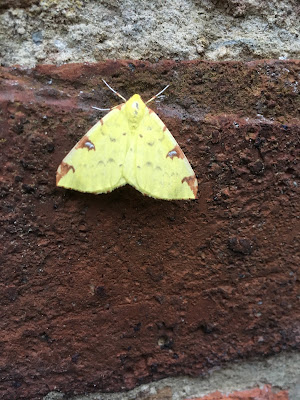
Moths of an Urban Garden #1 - The Brimstone Moth

Hi everyone. This is the first in a series of short blog posts that I'm planning to do, hopefully once a week, using photos of moths that I have taken in my garden, in urban Middlesbrough, and on nearby sites (such as Middle Marsh Nature Reserve).

For the first entry I've chosen the Brimstone Moth (Opisthograptis luteolata). Even though you quite likely have never seen, or even heard of this insect, it is very widespread and common in the British Isles being found everywhere except Shetland (in the very northern part of our archipelago).

Like many moths it mostly flies at night (unless disturbed accidentally during the daytime) but is found in hedgerows, gardens, parks and woodland where it lays its eggs on Blackthorn and Hawthorn and other shrubs, which the caterpillars will feed on after the eggs hatch.

The English name comes from an old name for the chemical element Sulphur, which is a pale yellow colour, like the moth. There is also a species of butterfly called the Brimstone, a much larger species which you may have seen flying along woodland rides in the early spring.

Although common, I have only caught Brimstone at my garden moth trap once (on the 1st of August 2021) since I started trapping there in 2018. As with all the moths I trap, this one was released unharmed when I let it go. After resting a while on my garden wall, it flew away into deeper cover where it was safe from predation by birds.

Saturday, 1 January 2022

NMT 2021 - the last few weeks - and a few reflections on the year

For one reason and another I wasn't able to get out birding as much as I would have liked in most of December. When I did it felt like very hard work seeing any birds at all other than really common species, so I was pleased to add two more species to the list before Big Ben's bongs at midnight on the 31st.

A trip to Cowpen Bewley Woodland Park on the 19th yielded the first of these.  I spent quite a while sitting watching the feeders that have been set up there (now in a different place than they were earlier in the year) and was rewarded with a couple of brief views of a Marsh Tit (NMT #173) as well as good numbers of Great, Blue and Coal Tits, a few Chaffinches, a lovely male Bullfinch, several Robins and Blackbirds, a couple of Jays, a Great Spotted Woodpecker calling (but not showing itself) and a tiny little Goldcrest (Britain's smallest bird).

On the 27th, after a lazy Christmas Day and Boxing Day, I took advantage of the calm conditions and did my last bike ride of the year, to South Gare. I timed my arrival very well, as one of the regular South Gare birders just happened to be at the very spot where a Woodcock (a shy, mostly nocturnal species) was roosting under a bush near the road. I would never have found it without his help as they are amazingly well-camouflaged. It wasn't new for the year (I saw one on the 1st of January) but it was my best ever view of one and,  I think, the first time I've ever seen one on the ground in 40-odd years of birding. Thanks Bob.


Eurasian Woodcock  at South Gare, 27th Dec 2021

Woodcocks breed in woodland over much of Britain with their populations being boosted in the winter months by many birds coming in from northern Europe where, presumably, the forest soils are frozen solid or covered in snow at this time of year, preventing them from reaching their prey of earthworms and other burrowing invertebrates.

Most of the rest of my time at the Gare was spent watching a female Velvet Scoter, and several other commoner waterbirds, from various different viewing points and eventually getting some not totally awful pictures of the scoter (my 174th species for the list and the last new bird of the year). The whitish blotch on the cheeks of this dark sea-duck distinguish it from females of the more regular Common Scoter, as well as the white wing patch which is present in both male and female Velvets and absent in Common. Although the white in the wing is only just barely visible (with the eye of imagination) in the photos below, I did get a good view of it when the bird was disturbed by a man in a kayak and flew to a different location.


A female Velvet Scoter at South Gare, 27th December 2021

The calm conditions allowed me to get this nice shot of a pair of Red-breasted
Mergansers (male on the left, female on the right), which flew in and landed
quite close to me while I was watching the Velvet Scoter


On the last morning of the year I spent some time on my local patch, Middle Marsh Nature Reserve in Middlesbrough, and although I didn't get any new birds for the year, I did see a Kingfisher a couple of times - my first here since February. 

Doing the NMT list this year has meant that I've done both more birding and more cycling in the year than I've done for a long time (possibly ever). It has, however, involved quite a lot of 'twitching' (see here for a discussion of the proper meaning of this term - Twitching, bird-watching and birding), even within the local area, as my decisions about where to go were often influenced by what birds other people had been seeing at different sites, and I am coming to the conclusion that a commoner bird that you find for yourself is often more satisfying than a rare one which someone else has found. 

It has shown me how easy it is to get to some good birding sites by bike, particularly Hartlepool, which I had previously thought was just too far but is actually quite easy (so long as the wind is not too strong) because of the lack of hills. I will definitely be spending more time there in the future, as well as at my two most visited sites of the year, Saltholme and South Gare.

In 2022 I intend to carry on doing most of my birding by bike or on foot but I have decided to focus much more on my two local patches: the big one which includes Middlesbrough Dock and the south bank of the Tees going as far as Smith's Dock in Redcar & Cleveland Borough and the small one - Middle Marsh Nature Reserve on Ormesby Beck. 

I haven't talked very much about Middle Marsh in this blog up to now but I'm planning to correct that this year with, hopefully weekly, updates about the birds, plants, insects and small mammals of this little urban post-industrial site near the middle of Middlesbrough.