Showing posts with label North Ormesby. Show all posts

Sunday, 9 January 2022

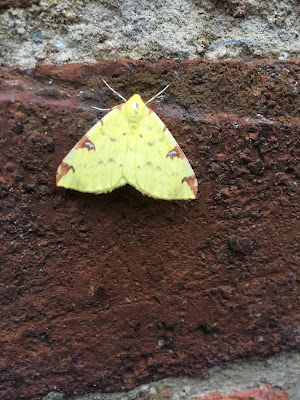
Moths of an Urban Garden #1 - The Brimstone Moth

Hi everyone. This is the first in a series of short blog posts that I'm planning to do, hopefully once a week, using photos of moths that I have taken in my garden, in urban Middlesbrough, and on nearby sites (such as Middle Marsh Nature Reserve).

For the first entry I've chosen the Brimstone Moth (Opisthograptis luteolata). Even though you quite likely have never seen, or even heard of this insect, it is very widespread and common in the British Isles being found everywhere except Shetland (in the very northern part of our archipelago).

Like many moths it mostly flies at night (unless disturbed accidentally during the daytime) but is found in hedgerows, gardens, parks and woodland where it lays its eggs on Blackthorn and Hawthorn and other shrubs, which the caterpillars will feed on after the eggs hatch.

The English name comes from an old name for the chemical element Sulphur, which is a pale yellow colour, like the moth. There is also a species of butterfly called the Brimstone, a much larger species which you may have seen flying along woodland rides in the early spring.

Although common, I have only caught Brimstone at my garden moth trap once (on the 1st of August 2021) since I started trapping there in 2018. As with all the moths I trap, this one was released unharmed when I let it go. After resting a while on my garden wall, it flew away into deeper cover where it was safe from predation by birds.

Sunday, 31 January 2021

The Big Garden Birdwatch

This morning I took part, for my fourth year (I think), in the Royal Society for the Protection of Birds (RSPB)'s annual Big Garden Bird Watch. This is a 'citizen science' event which the RSPB has been running since 1978, although it was quite a small thing until 2001. That was the year that it really started to grow in popularity - 50,000 people took part after it was opened up to non-members. Since then it's continued to grow and last year half a million people counted almost 8 million birds. Yes you read that right - HALF A MILLION PEOPLE!!!

To take part in the BGBW all you have to do is register for the count on the RSBP's website (it's free) and then count the birds in your garden for one hour at some point during the last weekend in January. The last stage is to send the figures in to the RSPB via the link on the website (you can do it by post as well). You don't need to be an expert birder - there are lots of resources available on the website to help you identify the common birds in your garden, so even if you can only identify Blue Tits, Blackbirds and House Sparrows it's worth taking part. It'll have to be next year though as today was the last day of this years BGBW (although there's still a few hours of daylight left as I write so you might still be able to get in if I can get this blog written really quickly).

I wasn't very optimistic for this year's count as we've hardly had any birds at our feeders so far this winter. However, from what I can see of my data in previous years (I can't find any notes from 2019 and I can't remember if I actually did it that year or not) this has actually been the BEST YEAR EVER for my garden in urban Middlesbrough.

I was still in my dressing gown, sitting in my bedroom window from 8.26am to 9.26am and from the first minute there was no point when there weren't some birds visible in the garden. The feeders themselves were a bit disappointing, with only two Blue Tits and one Robin coming to the hanging feeders.  What really attracted the birds however were the two piles of mixed food that I had put out - one on the ground and one on an old concrete coal bunker. 

The first bird I saw was a male Blackbird on the coal bunker and he came back several times during the hour. He was joined at various points by two Dunnocks, five House Sparrows, at least three Woodpigeons and two Collared Doves. A Magpie in the tree next door, two Feral Pigeons and two Starlings on our roof and a Herring Gull on the roof of a house across the alley also count (according to my understanding of the rules anyway) but the flock of five Goldfinches that flew over don't, as you're not supposed to include birds that are only seen in flight. That brings the species count to 11. My previous record was 5, so even if you take out the Magpie and the Herring Gull that weren't actually in our garden it still beats that into a cocked hat.

In other bird news this week - a long walk around the National Trust's Ormesby Hall property on Monday helped me add two more species to my NMT bird list. These were:

#67 - Eurasian Nuthatch  - I heard two or three of these noisy birds but unfortunately didn't get to see any this time, despite looking carefully for the distinctive sight of a slate-grey, red and white bird with a black pirate mask creeping up and down tree trunks and along branches. It still counts though. The other new NMT bird was:

#68 - Stock Dove - I thought I was going to miss out on this smaller cousin of the Woodpigeon until I saw one flying over towards the end of my walk. Last year at this time I was already hearing them 'singing' their mournful, two-note coo, but I listened in vain this time. 

I had hoped to see a Treecreeper - the closest thing we have to a mouse in bird form - spiralling up a tree trunk to find its insect prey, but despite looking in all the places I saw them last year I had no luck. There were really good numbers of other common woodland birds though, including Coal, Blue, Great and Long-tailed Tits.

I didn't manage to get any pictures of the new birds this week so here are a couple of pictures of one of the Great Tits that I saw last Sunday at the feeders by Normanby Beck (see NMT 17th-24th Jan 2021). Not brilliant pics I know but I quite like the action shot of it taking off.


Saturday, 16 January 2021

Bike and Boots Birding again

Hi everyone, 

it's the 16th of Jan, so exactly a week after I last posted and time for an update on my Non-motorised Transport Bird List. 

I didn't do any big trips this week - just walks and a couple of short cycle rides in my local area, so I'll just list the new birds I added and tell you about them (with pictures if I've got them).

#58 - Eurasian Sparrowhawk (although birders just cal this Sparrowhawk as the nearest other species with Sparrowhawk as part of the name are a continent away) - I only got a glimpse of this one on a visit to my local patch. It was perched on the fence as I walked past it and it flew away giving only enough of a view to be sure of the species but not say anything about whether it was male or female or anything else. It's always nice to see a Sparrowhawk though.

#59  -  Little Grebe - This is a small waterbird, superficially a bit like a duck but not very closely related. The grebes (of which we have 5 that are regularly seen in Britain and Ireland), dive to catch their prey and don't like to come out of the water. If they are alarmed the will dive underwater and swim away rather than flying. Because their legs are set very far back on their bodies they are very good swimmers but terrible at walking on land (the Divers (known as Loons in North America) are very similar in this regard).
This one was an exciting bird for me as it was the first one that I have seen on my local patch (although I see them frequently at Saltholme RSPB reserve which is only a couple of miles away as the grebe flies)

The scientific name of Little Grebe, Tachybaptus ruficollis, means
'fast diver with the red neck' - which I think is s pretty good description


#60 - Common Linnet  -  This is a very common bird over nearly all of the UK and Ireland but the flock of about 20 that I saw today, were only the second time I have seen it on my local patch (North Ormesby Middle Marsh Nature Area). The light wasn't very good today so the photo here is of the pair I saw last summer. The ones I saw today were all in non-breeding plumage so they all looked pretty much like the female (on the left) in this picture.


#61 - Mistle Thrush  - This large thrush stays with us all year round but I've not seen very many since I moved to Middlesbrough in 2016 so I don't think they're very common around here. I saw two together today. The name comes from their fondness for Mistletoe berries


#62 - Red-breasted Merganser  - Mergansers are fish-eating ducks, in the group known as 'sawbills' because of the serrations on their beaks which help them to hold onto their slippery prey. Red-breasted Mergansers are very coastal birds but they do come up the River Tees as far as Middlesbrough, where I saw this one today. This is a female (with her reddish head - the male's head is dark green) and unfortuately I wasn't able to get a very good picture before it flew off, so you'll have to make do with some bad ones.


This would have been the best one if it had been in focus 
- however, you can still see the thin red bill and the punk hairstyle


Friday, 1 January 2021

Lists in general and my 'Non-motorised Birding - 2021' in particular

Birders love keeping lists of the birds they have seen - in the whole world,  in specific geographical areas such as continents, countries and  counties or in smaller areas such as a local 'patch' or their own garden. Some people keep lists of birds they've seen from a moving car, or identified without binoculars, or seen in movies (presumably not including nature documentaries which surely would be cheating). 

Lists can be a great way of making birding even more fun than it already is by bringing an element of competition into it - even if you're only competing with yourself or a small group of friends. As with anything, listing can be taken to extremes - such as in the film The Big Year (based on a true story) where three people attempted to beat each other to the record for the most species seen in the US & Canada in one year, or the case of the  birder who left his wedding reception to race after a new bird for his 'British List'.

Although I have never gone to such extremes, I do keep my fair share of lists - I have a list for every country I've ever been in, a list of birds I have found for myself in Britain and Ireland, a list for my local 'patch', and even one of birds that I have identified in my sleep (there's only one bird on this list - during a trip to Portugal I dreamt I heard a European Serin singing, only to wake up and realise that it was a real one singing outside my bedroom window). 

In 2010, while I lived just outside Vancouver in Canada, I was part of a group of birders in the area who kept lists of birds seen using only 'non-motorised transport' (NMT-lists for short). It was a great incentive for me to get out birding as often as possible - and also to get lots of exercise as I racked up hundreds of kilometres cycling all over the Vancouver area, and to meet brilliant people I wouldn't otherwise have met. Sadly I had to leave before the year was over but in nine months I added 155 species to my NMT list including several that were completely new birds (lifers) for me and some that I still haven't seen anywhere else - notably Great Grey Owl, Cinnamon Teal and Black Oystercatcher.

Every year since moving to Middlesbrough I have been toying with the idea of doing an NMT year here, and I have now decided that 2021 will be the year. I am going to use the same rules we did in 2010 - I can count anything I see having journeyed from my house without using a car, bus, motorbike, power boat plane etc. Once I have used any form of motorized transport I can't count any more birds until I go back to home and start again. By these rules, I could cycle to the North York Moors from my home in North Ormesby, and come home on the train but I wouldn't be allowed to add anything to the list after I got onto the train until I get back to the house. Unfortunately the same rules apply to the Tees Transporter Bridge, which, despite the name is actually a motorised form of transport, so I am foreseeing a few long cycle rides to areas north of the river this year (I can use it on the way home though).

I made a small start on my NMT 2021 list today, which is New Year's Day, with a walk around a couple of my local patches - North Ormesby Middle Marsh (part of which has just been made a nature reserve), and Middlesbrough Dock.  It was fairly quiet, birdwise, but the undoubted highlight was a Woodcock (Scolopax rusticola) which was almost my last bird of the day - it was flushed by dog walkers and flew past me, as I was walking through the new Nature Reserve just as the light was starting to fade. Other unusual sightings were a female Blackcap (this species is best known as a summer visitor although small numbers spend the winter in Britain now) and 3 Mute Swans doing something I have never seen before - stretching up to graze on green algae on the wall at the edge of Middlesbrough Dock. As soon as I came along they stopped doing it and came towards me, expecting bread I think, so I didn't get a good photo. 

My list now stands at 25 birds - I've included the whole list at the bottom of this blog. From now on I will post weekly updates with new birds and the number they are in the list. There are several easy species missing from the list, including Dunnock, Wren and Great Tit, but that is the nature of birding.

#1   - Herring Gull - also first bird of the year of course
#2   - Pied Wagtail
#3   - Feral Pigeon
#4   - Blackbird
#5   - Carrion Crow
#6   - Jackdaw
#7   - Magpie
#8   - Goldfinch
#9   - Long-tailed Tit
#10 - Black-headed Gull
#11 - Robin
#12 - Mallard
#13 - Cormorant
#14 - Great Black-backed Gull
#15 - Mute Swan
#16 - Moorhen
#17 - Redshank
#18 - Bullfinch
#19 - Blue Tit
#20 - Blackcap 
#21 - Starling
#22 - Woodpigeon
#23 - Song Thrush
#24 - Jay
#25 - Woodcock


Thursday, 29 October 2020

Birding on my local patch

 After dropping the car off for a service this morning I decided to walk home via my favourite little local birding 'patch' - along the lower reaches of Ormesby Beck in North Ormesby. This is a fairly unremarkable-looking little stream, with lots of the problems you might associate with urban rivers and brooks - poor water quality, large amounts of rubbish washed downstream, a straightened course running mostly in a concrete channel, development right up to the riverbanks - but even so, over the last few years I have seen or heard at least 48 species of bird along the beck and in the grassland and woods next to it (just under 10 hectares (about 24 acres) in area).

This morning my bird-list was about half that total but it included several species which are a bit special or which I don't see very often in the area. The first bird I saw when I looked over the concrete wall next to a beck-side pub (the Navigation Inn) was a Little Egret - an elegant white heron. Unfortunately I didn't have my camera with me but was able to get three rather blurry photos with my phone which still manage to give an impression of how unnatural looking the channel is at that point, with steep walls, discarded tyres and other rubbish. You can also see, from the different position of the Egret's head and neck in the three photos that it appears to be actively hunting, so there is obviously some prey, probably small fish, there for it to catch.


 A little further down the beck from where I first saw the Egret, in a slightly more natural stretch (with vegetated banks and a little bit of tidal mud, although still in a straightened channel with lots of rubbish) I saw it again but this time flying away along with a Grey Heron and a Redshank. The Redshank, which is a fairly common wading bird in the Sandpiper family, was only the second one I have seen on my local patch and I was later able to watch it for several minutes on the mud at the point where another beck, Middle Beck, comes out of its underground culvert to join Ormesby Beck above ground.

After wandering along the beck for a while, watching an over-excited flock of Long-tailed Tits (joined at times by Blackbirds, Robins, Great Tits and Blue Tits) I came back to the mouth of Middle Beck and was really pleased to see a Grey Wagtail - the first one that I have recorded here, although I've seen them several times in North Ormesby, including in my own garden (see this blog entry from last year - http://northormesbynaturalist.blogspot.com/2019/10/the-making-of-pond-and-unexpected.html). This pretty little, long-tailed bird is often misidentified by inexperienced birders as the much scarcer Yellow Wagtail, as it has a lot of yellow in its underparts. However, as well as being an unlikely visitor to an urban stream such as this, Yellow Wagtails are summer visitors to the UK and should all be on their way to Africa by now.

The next exciting thing I spotted was a Kingfisher. Although I've seen Kingfishers on this stretch of the beck on a few occasions, it has previously always been birds flying along the river, and so I didn't have any definite evidence that they were using it as anything other than a convenient corridor to fly along between better patches of habitat. However, today was the first time that I have seen one actually diving into the beck, proving that they do linger here to hunt for the little fish that they live on.

Having seen or heard 20 species of bird along 500m of the beck channel (going downstream from the Navigation Inn, Marsh Road, North Ormesby, if you want to look at it in Google Maps), I headed towards home adding a further three species to the day's list on the way - Magpie (much vilified, very common, but nonetheless beautiful), a very fast-flying Sparrowhawk, and my first Common Teal for the patch since 2017. The Teal was a male with his lovely chestnut head and bottle green 'eye-mask' and he made a great end to an unplanned bit of patch birding.


Ivy - Villain or Hero

My October article for The Tees Online has just been published (https://thetees.online/ivy-villain-or-hero/) but to make it easier for you, here is the text plus a few more photos.

"October Nature: Ivy - Hero or Villain?


What comes to mind when you think of Ivy? For many people it will bring up images of a pesky climbing weed that strangles trees, damages walls and fences and is no good for anything.


In fact Ivy, or Hedera helix to give it its scientific name, is a wonderful and unjustly vilified  plant that is great for wildlife in many different ways. 


Firstly, because it flowers in autumn it is a very important source of nectar for many species of insect at a time of year when few other plants are flowering and insects would really struggle without it. Although the flowers are more inconspicuous than those of many species, being mostly  pale green and lacking petals, a small patch of ivy can have hundreds of flower heads and provides food for large numbers of bees, wasps, hoverflies, butterflies and many other insects.


The insignificant looking flowers of Ivy are a rich source of 

nectar for insects late in the year in the UK


Many species of hoverflies, some of which have evolved to look like wasps to 

scare off potential predators, feed on Ivy flowers in the autumn


Later in the winter the flowers will develop into black berries which will help birds such as Blackbirds, Woodpigeons, Redwings and Fieldfares (the last two being migratory members of the Thrush family) survive the harshest months of the year.


In the winter months, patches of ground covered in Ivy may remain frost free when nearby areas are frozen solid. This allows birds and small mammals to continue searching for food in the leaf litter during icy weather. Also, its twisting, intertwining branches and stems, and its evergreen leaves, create many niches and hollows in which birds and other animals such as Wood Mice can find shelter from severe weather. In the spring and summer many birds build their nests in ivy to raise their young.


The commonest accusation levelled against this great plant is that it strangles trees. Ivy uses trees, to give it support and allow it to reach up towards the sunlight but it is not a parasite which feeds off them (unlike another, much more popular, evergreen plant - Mistletoe), and its presence is not a sign of an unhealthy tree. However, trees don’t live forever and have a natural life cycle involving different stages. Ivy will sometimes play a role in helping an old tree move along this continuum, from the vertical to the horizontal, as it were, and may bring trees down by acting as a sail during high winds, or by holding a great weight of snow after blizzards. This still doesn’t mean that Ivy is a villain though, as dead wood is an important part of a woodland ecosystem and the toppling of trees opens up the canopy, allowing sunlight to reach the forest floor and exposing bare soil. This lets plants and animals flourish that otherwise wouldn’t be able to compete.


But surely Ivy is still bad for buildings, I hear you say. Well, a three year study carried out jointly by Oxford University and English Heritage showed that, while it could make existing damage worse, it also had a positive effect in some cases by keeping walls warmer in the winter and cooler in the summer and by protecting them from salt and airborne pollution.


The familiar lobed leaves, which give the name to several 

other unrelated plants (such as Ivy-leaved Toadflax 

and Ivy-leaved Speedwell) are found on young plants only. 

More mature plants have simple oval-shaped leaves


Finally, Ivy features prominently in folklore. Bacchus, the Roman god of wine, the grape-harvest and fertility, is often depicted wreathed in Ivy as well as the more predictable grape-vines. It also symbolised intellectual prowess in ancient Rome and Ivy wreaths were given to the winners of poetry contests. It was also a symbol of fidelity and even today it is common for bridal bouquets to contain a sprig of this amazing, interesting and important evergreen plant."

The oval shape of the leaves, as well as the presence
of flowers, shows that this is a mature Ivy plant

A Honey-bee (Apis mellifera) feeding on Ivy flowers

Ivy berries just starting to form. Later in the
Winter these will be black


Wednesday, 30 September 2020

A couple of articles I wrote - plus some extra photos

Hi all, for the last couple of months I have been writing a monthly 'nature column' for my local on-line Newspaper. 

The first one I wrote was in August. It had the title "August - a month of two seasons" and in it I talked about how, in the UK at least, August is both part of summer (with hot weather and lots of flowers still blooming) and part of autumn (if you're a migrating wader for example). To read about that go to : https://thetees.online/august-a-month-of-two-seasons/

This month's one, which went live on the 25th of September, was called Ducks, ducks and 'ducks'. In it I propound the theory that, despite what the books will tell you, there are three kinds of ducks:- Ducks that are Mallards, ducks that aren't Mallards, and ducks that aren't ducks at all. To read about that and to see if you agree with me, go to: https://thetees.online/ducks-ducks-and-ducks/

And now here are some of the photos that I didn't have space to include in the articles:-

Great Willowherb at Saltholme RSPB, 19th Aug 2020

Toadflax near Redcar, 23rd Aug 2020

Bar-tailed Godwits at South Gare 30th Sept 2018

A (slightly blurry) Black-tailed Godwit, still in its brick-red
breeding plumage on the way from its northern nesting
grounds to its wintering area (photo taken at Greatham Creek, 
Teesside, 15th August 2020)

A Grey Plover changing out of summer (breeding) plumage during 
its autumn migration - Seal Sands, Teesside, 15th Aug 2020


Coot at Coatham Marsh, Redcar, 13th Sept 2020

A Mallard with some domestic genes.
Albert Park, Middlesbrough 12th Sept 2020

A male Mallard in 'eclipse plumage' (see Species Spotlight - Day 31 - Shoveler 
for an explanation of this). Despite his unusual look, this is an ordinary
Mallard, not a domestic one

Male and female Gadwalls at Coatham Marsh, Redcar, 13th Sept 2020


A Little Grebe (not a duck) and a male Gadwall (a duck that isn't a
Mallard) - Coatham Marsh, Redcar 13th Sept 2020


Tuesday, 1 October 2019

The making of a pond and an unexpected visitor

Sue and I have just had a lovely, unexpected and very welcome visitor in our garden - a young Grey Wagtail, drawn in by our new pond, which we only made on Saturday (today is Tuesday). I would call that a success for our (still developing) wildlife garden .

The pond is actually a bit unusual (those who know me will be surprised by that not one little bit) - it is made from an old bath which had been fly-tipped in our back alleyway and which I asked for when the council were getting it cleared away. I have been gradually developing a ‘wild area’ in one corner of our garden over the past year and a half. When we moved in, the entire garden was covered in concrete, wooden decking and gravel on top of blue plastic sheeting and it has been quite a job turning it into a nice garden (we’re not finished yet). This latest stage involved digging a trench about 2 metres long, 1 metre wide, and slightly less than half a metre deep and putting the bath into it (having first purchased the right size of plug - 75p from one of our local hardware shops). The soil here, below the top 6 inches or so, is full of broken bits of brick and so I needed to use a pickaxe to loosen it before I could make any headway through it. Below that, luckily starting at about the depth I needed the trench to be, is a hard layer which appears to be very dense clay and it is this that the bath, aka my pond liner, is now resting. I used some of the soil I had dug out to fill in the gaps around the sides of the bath as much as possible.

Once the bath was in place I put some soil, gravel, rocks and all the broken brick I had dug out, inside it to give insects and plants something to burrow/ root into and also to allow any non-aquatic creatures to climb out easily. Then I filled it using water from our rain-water butt, using two watering cans. See the attached photos that Sue took at different stages of the process. The final result was a rather eccentric type of small pond with a little rocky island and no plants growing in it yet. 

I was quite please with the end result but I wasn’t expecting it to attract any wildlife this soon after its creation. Add to that the fact that we have not had many birds of any sort in our garden over the summer, since we took most of the feeders down in the spring. I had only just put them back up again a few days before the creation of the pond and although I had seen evidence of birds visiting them (peck marks in the peanuts), I hadn’t actually seen anything on them until this afternoon. I looked out of our bedroom window (the best place to view the feeders) and saw, first two Collared Doves, then a bunch of House Sparrows on the ground and on the peanut feeder, and then I noticed something on the side of the new pond - a small bird, similar in size to the sparrows but with about half of its length taken up by a long tail, which it was constantly wagging up and down. A Grey Wagtail! Many of you will be familiar with Pied Wagtails - black, white and grey birds, common in towns and cities in the UK. Well, Grey Wagtails are similar in size and shape (with a slightly longer tail), but with a smooth grey back and varying amounts of yellow on the underparts. This particular one had bright yellow under its tailbase, and on its rump but the rest of its belly was whitish. Its throat and upper breast were a nice pale peachy buff colour, with no black patch, and it had a little pale line above each eye. This combination of features told me that it was an immature bird, hatched earlier this year. It is too early to be able to tell what sex it is, although next year, if it is a male, it will have a jet black throat and yellow from its throat to its tail.

Wagtails are closely related to pipits, and like them are fine-billed, insect-eating birds, but a generally much more colourful and interesting to look at than pipits, most of which are very similar looking streaky brown birds - the archetypal LBJs (Little Brown Jobs). There are three wagtail species which breed in Britain - the Pied Wagtail (which is actually the British and Irish race of the much more widespread White Wagtail), the Grey Wagtail, and the Yellow Wagtail. Many people, on seeing their first Grey Wagtail, mistake it for a Yellow. This is understandable, but Yellows are actually quite different - smaller, yellower and unlike Pieds and Greys, Yellow Wagtails are not here all the year round. Instead they migrate to Africa for the winter. They are also much scarcer than either of the other two species and are not usually found in towns, preferring instead wet grassland habitats and marshes.

Grey Wagtails like fast flowing upland streams, but also any kind of watery habitat, including urban canals and park lakes. When I was young I would have expected to have to go to a wild, hilly place to be able to see one - in fact I saw my first one in the hills of the Peak District in Derbyshire at the age of 16. I was very excited. Now, however, they can be found over most of lowland Britain, although you are still more likely to see one near a fast flowing stream than an urban garden pond/bath, and I admit that I was almost as excited to see my most recent Grey Wagtail as I was to see that first one, all those years ago.

I wasn't able to get a picture of today's bird, but click here to see some pictures and some more information about Grey Wagtails - Grey Wagtail Bird Facts - RSPB


The bath - prior to being given a new function
Preparing the ground
Ready to be filled
The ceremonial filling of the pond
The finished product

All photos © Sue Conroy


Thursday, 10 January 2019

A winter's day in Doggy

I had a little walk around my local area today, and rather than writing down notes, I used the voice-memo function on my phone to record myself doing a running commentary as I walked along.

This is a (very slightly edited) transcript of that recording.

Thursday, around 2pm:

I’ve come out of the library in North Ormesby ('Doggy' to its friends) and I hear the sound of Starlings and House Sparrows chattering. It’s really quite loud, and as I go onto Esk Street I see in the hedgerow a good twenty or thirty House Sparrows and a similar number of Starlings. They’re making a right racket. A bit further down two Blackbirds hop out of the hedge onto the pavement and I can hear another one flying behind me and making that rattling, scolding call that they do.
Overhead is a flock of Starlings and there’s a seagull… it looks like a Herring Gull I think. And there’s another Herring Gull, flying over the houses on Maria Street. As I walk a bit further down Esk Street a Pied Wagtail flies up off the road - I didn’t even see it there until it flew. I hear it doing its ‘chizzik, chizzik’  flight-call (leading some people to call them “Chiswick Fly-overs”).
A couple of Carrion Crows up in a Sycamore tree are joined by another Blackbird.

The new play area on Esk Street is looking quite nice now. The grass is all grown. The new evergreen shrubs in the flowerbeds with all the bark chipping underneath them… they’re looking quite well maintained, and there’s cherry blossom just coming out. Oh, and there’s a Long-tailed Tit, flying along the little line of young trees that have been planted, to the lovely little blossom tree. Now I can hear the ‘drr drr drr’ of a small flock of Long-tailed Tits. There’s one, two, three... four, five, six, seven… eight. Tiny little pink, white and black birds like a fuzzy ping-pong ball with a long tail. And they’ve gone into the honeysuckle, erm, hedge I suppose you’d call it, next to the basketball court. Just behind them is where all the fairground equipment is stored. It looks like just a big storage yard but there’s still life there.
In the playground, amongst all the grass there’s Red Deadnettle, Groundsel, Field Speedwell, Chickweed, Spear Thistle, what looks like a Dock (maybe Broad-leafed Dock),  Sow-thistle. The grass is growing through the plastic netting they’ve put down to protect it - it’s looking okay. It’s still winter and once it gets a bit warmer I’m sure it’ll grow well and you won’t be able to see the netting.
One of the young trees has been broken off by vandals but there are some shoots growing from the bottom, so that’ll still survive.

Walking down the footpath from Esk Street, down towards James Street … it’s actually nicer than I remember. There’s a bit of litter and a bit of dog poo, but it’s more open, less enclosed than I remember it being. Going past the school on one side and the yard with the fairground equipment on the other. A couple of guys are welding some of the equipment together - doing repairs I think, getting ready for the spring and summer season.
I can hear more House Sparrows in the hedge now, and there’s a couple of Woodpigeons just flown away. And the catkins in a small Alder tree. There are two different kinds of catkins … male ones hanging down - yellow with pollen - and the little female cones that look a bit like tiny pine cones.
A little bird hops across the path. What is it? Oh, I can see - it’s a Dunnock. Its greyish head and brown streaky body. Like a Robin but without the red breast and with more grey on the head. My mother (and everyone of her generation) used to call them Hedge Sparrows, but they're not closely related to our other sparrows.

And round onto James Street. Up in the tree - what are those things up there… like round balls. As I get closer I can see they are Woodpigeons.
I like the way they’ve used old tyres, in the school playground, and also in the Esk Street playground - they’ve half buried them, so that the top bit’s sticking out and they make, like a kind of mini obstacle course I suppose.
There are a couple of Goldfinches up there in a tree on James Street - just chattering away, making buzzy calls with little twittery notes.

Walking further down James Street to Harrison Street - there are two big planters with nothing in them, apart from wood chips, covering the soil. They’re a good three metres by seven metres, with car parking spaces in between them. Something could be done with that I think.

Coming round towards the church and the Market Square, I can hear more Starlings up on the church tower. They seem to like the high vantage point. 
These trees in front of the church had a flock of 60-odd Waxwings in a couple of years ago… no sign of any this year, although there were a few over in Sainsbury’s car park in Middlesbrough a couple of weeks ago. They're pretty birds, like a pink Starling, with  funny hairdo and waxy red and yellow tips to the wings. They come down from Scandinavia in winter to feed on our berries. They seem to like the trees that they plant in supermarket car parks and housing estates.
There’s a lone Black-headed Gull on top of a street light at the end of Kings Road on James Street. He’s not got his (or maybe her) black head, because he’s in winter plumage.

After walking down the first bit of Kings Road I turn right, and then left onto Kreuger Alley (I wonder where Kreuger Alley gets its name from). There’s lots of Pyracantha - Firethorn - here, with its little orange and red berries. That should be good for birds to feed on.
Going further down Kreuger Alley there’s a big open area where it looks like maybe a couple of houses were knocked down - it’s all sort of waste ground… sometimes cars park on it. Looking through onto Westbourne Grove, there’s a whole lot of Buddleia in there which is providing cover for some birds that I can see. What’s that? Oh, it’s another Blackbird. Its just flown out onto a garage roof.
And there’s a Feral Pigeon strutting around in the site of another former house - it’s drinking out of a puddle. It’s lifting its head after every mouthful - which is interesting because I read that pigeons are among the few birds that can suck water up without having to lift their heads to let the water roll down their throat… this one’s definitely lifting its head though. I can hear the sound of the pigeons wings as they flap away.
I didn’t realise this alleyway had a name until today, but this is still Kreuger Alley. Coming up to the end of the alley, to where it comes out onto Kings Road, there’s the back yard of a house with a high wall and lots of broken glass stuck on the top of it - just next to that there’s a whole lot Clematis growing over the top of the wall. It’s been cut back a bit but it looks like it might be quite nice when it’s flowering.

Getting back to my house - I can see that I really need to tidy up the front yard. There’s a whole lot of litter that’s been blown into the corner underneath the plants. And lots of grass growing out from amongst the slabs. You might think grass is just grass, but a lot of this is a plant called Water-bent (a funny name for something that grows out of dry paths and pavement edges). It’s not native to this country but has colonised cracks in paving stones, starting off in London and working its way around the country… so it’s definitely made it up as far as Middlesbrough. 

And now I'm home and it's time for a cup of tea!"


Sunday, 19 August 2018

Vertical gardens - the flora of the walls of North Ormesby

This morning on my way home from church I went for a little walk around the place where I live - North Ormesby, aka Doggy (apparently a corruption of 'Dock End'). There are lots of old brick walls here, many of which are in quite bad repair, with graffiti and boarded up windows, but also with lots of plants growing out of them, so I decided to take pictures of as many different plant species as I could and tell you a bit about them.
The most obvious group of plants which grow on walls in the UK is the ferns. Ferns grown in many different types of habitats as well as walls, but there are some species (such as many of the Spleenworts (Asplenium  spp.) and the Polypodies (Polypodium spp.)) which rely largely on walls, rock-faces and other vertical surfaces (e.g. trees in some places), while others, such as Male-fern (Dryopteris filix-mas) are more commonly seen on woodland floors but will also happily live on walls as well.
Today I found four fern species growing on the walls I walked past - Hart's-tongue (Asplenium scolopendrium), Maidenhair Spleenwort (Asplenium trichomanes), Wall-rue (Asplenium ruta-muraria)  and Male-fern. In a few places they were growing quite densely along with other kinds of plants. Generally, the more neglected the wall, the richer the flora was, and in some places there were even small trees growing out of cracks. Closer inspection of the pictures will show that most, if not all, of the plants are actually growing on the mortar holding the walls together. This is rich in lime (calcium carbonate) which would naturally be found in alkaline rocks such as limestone and chalk, and this may explain why at least some of the species do so well on walls.
Wall-rue
Maidenhair Spleenwort, with a little bit of Wall-rue poking through it
(I took this photo in 2016 just outside North Ormesby)
Newer walls can have ferns too. This is Male-fern growing with Wall-rue
Hart's-tongue (left) and Maidenhair Spleenwort (right)
A single Male-fern growing with lots of Wall-rue
A rich growth of four species of fern in one place, along with a
few mosses (which, sadly, I am not able to identify)
Buddleia (Buddleja davidii) - a very successful non-native species in the UK.
It really likes  walls, alleyways, factory roofs, and waste-ground.
Its beautiful flowers are very attractive to many of our native butterflies, so ecologists
don't tend to mind it as much as some of the more problematic invasives.
A little moss-like flowering plant called Procumbent Pearlwort (Sagina procumbens).
If you live in the UK, look between the cracks in the pavement next time you go out
and you will probably see this very widespread but very inconspicuous plant
Annual Pearlwort (Sagina apetala) - a close relative of Procumbent Pearlwort,
here growing with Wall-rue and Maidenhair Spleenwort
Pellitory-of-the-wall (Parietaria judaica). This relative of  Stinging Nettle
is widespread on walls in the UK. Its pollen, apparently, is highly
allergenic, so if you suffer from hay-fever, don't sniff it.
One of two species of Bellflower (Campanula portenschlagiana  or  poscharskyana)
which are common escapees from gardens in England and Wales
Herb Robert (Geranium robertianum) - a very common plant of
woodland, hedgerows and waste-ground. It is less common on walls
Grass doesn't just grow on lawns. This one is the very inappropriately named Water Bent (Polygon viridis), an alien species in the UK, which is proving quite successful at colonising dry habitats in urban areas
A young birch tree (Betula sp.) in a very unusual place -
a wall in the car park at the back of Barclays Bank