Showing posts with label Middlesbrough. Show all posts

Sunday, 9 January 2022

Moths of an Urban Garden #1 - The Brimstone Moth

Hi everyone. This is the first in a series of short blog posts that I'm planning to do, hopefully once a week, using photos of moths that I have taken in my garden, in urban Middlesbrough, and on nearby sites (such as Middle Marsh Nature Reserve).

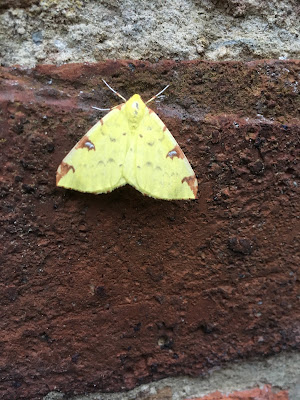
For the first entry I've chosen the Brimstone Moth (Opisthograptis luteolata). Even though you quite likely have never seen, or even heard of this insect, it is very widespread and common in the British Isles being found everywhere except Shetland (in the very northern part of our archipelago).

Like many moths it mostly flies at night (unless disturbed accidentally during the daytime) but is found in hedgerows, gardens, parks and woodland where it lays its eggs on Blackthorn and Hawthorn and other shrubs, which the caterpillars will feed on after the eggs hatch.

The English name comes from an old name for the chemical element Sulphur, which is a pale yellow colour, like the moth. There is also a species of butterfly called the Brimstone, a much larger species which you may have seen flying along woodland rides in the early spring.

Although common, I have only caught Brimstone at my garden moth trap once (on the 1st of August 2021) since I started trapping there in 2018. As with all the moths I trap, this one was released unharmed when I let it go. After resting a while on my garden wall, it flew away into deeper cover where it was safe from predation by birds.

Friday, 12 March 2021

Avocets, Thrushes, Snow Buntings and a winter flower - four articles I have written recently

It's been a while since I've shared the links for my posts on The Tees Online (https://thetees.online/) - the local website that I write articles (well, blogs basically) on once a month. Below are the links for the last four (including one that went live today), plus a few of the photos to give you a taster before you click.

https://thetees.online/avocets-return-to-the-tees/

Close-up of an Avocet - photo by Dave Barlow


Fieldfare on the hunt for worms (probably) at Cowpen Marsh
- photo by Colin Conroy


Common Whitlowgrass flowers - photo by Kevin Widdowson

https://thetees.online/spotting-the-elusive-snow-bunting-at-south-gare/

Snow Buntings at South Gare - photo by Colin Conroy


Tuesday, 16 February 2021

Saltholme, Greatham Creek, Bellingham Beck and a couple of surprises at home afterwards

After nearly two weeks without any birding I was able to get out for a bike ride on Saturday. I hadn't been north of the Tees yet this year so I took advantage of the clear weather (although very cold and fairly windy) that was forecast, and headed across the Newport Bridge and along Haverton Hill Road towards Saltholme RSPB Reserve.

A few gulls on the river as I went over the bridge, and a Long-tailed Tit in the bushes just after it, were the first birds of the trip, but I didn't stop until I got to the village of Port Clarence. A flock of thrushes on both sides of the road there were enough incentive to stop (plus I needed a rest) as I still hadn't seen Fieldfare yet this year. However they were all Redwings.

After turning onto the Seaton Carew Road I started seeing a lot more birds - 4 Common Snipe that flew off one of the few unfrozen puddles at the side of the road were the first of many (at least 30 I think) that I saw during the day. A few metres further on a harsh, loud, chattering call got my attention and I saw my first Fieldfare of the year, and the first new NMT bird of the day (#69). The Fieldfare is a large thrush (a bit smaller than a Mistle Thrush but larger than Redwing and Song Thrush) that breeds in northern and central Europe  and comes to these shores in the winter. I think it is the most beautiful of our thrushes - it is certainly the most colourful, with its grey head, chestnut brown back, orangey front (with black spots), white belly and black tail. Unlike many thrushes they often nest in small colonies where they can be quite feisty when threatened by a predator - I watched a nature documentary years ago (David Attenborough I think) that showed a group of them attacking a young Raven which strayed too near the colony. Instead of just shouting at it, as many birds do, they dive bombed it with their droppings until its feathers were so gummed up that it couldn't fly.

This Fieldfare was one of many that I saw later in the day - 
posing nicely for photos on the new banks at the sides of
Cowpen Marsh and Greatham Creek


Moving on, I got to the open water of Saltholme, on both sides of the road. Or rather, what is usually open water. After the freezing weather of the previous week it was nearly all ice, with only small patches in the middle that were unfrozen. In these patches lots of wildfowl were gathered - mostly fairly distant Canada Geese on the West Pool, but a mixed group of ducks and Coot on the East Pool. 

By the time I left this area to take a detour to Dorman's Pool I had increased my NMT list to 73 - having added (as well as the Fieldfare), Coot, Lapwing (about 140 on the field next to Saltholme East), Wigeon and Shoveler.

A view across a frozen landscape toward the new(ish) Saltholme Pools hide


Eurasian Wigeon, Tufted Ducks and Mallard - there were also several
Shoveler and Coot here, but I didn't get any pictures of them

A cropped version of the previous pic showing that some of the Mallards and
Wigeon were standing on the ice. There's only one Mallard (a male) in this
picture btw. All the other birds are Wigeon - the males with red-and-buff heads,
the females plainer brown - all with bluish beaks

Dorman's Pool was in a similar state to those at Saltholme - mostly frozen with a little bit of open water in the middle, although the birds were different. A knot of about 7 swans sitting directly on the ice (apparently) teased me by keeping their heads tucked under wings most of the time but the few that looked up were definitely Mute Swans and they all seemed the same size and shape so my hope of adding Whooper Swan to the list was thwarted. Several Snipe flew out out of the long grass next to the car park, but one heavier bird proved to be a Woodcock, my second of the year. Dorman's is the best place in the area to see the elusive Bearded Tit but they were staying out of sight in the reeds on this occasion.

Next was a quick visit to the Saltholme car park and visitor centre where I added Tree Sparrow to the list for the day and the year (NMT #74). This much scarcer relative of the House Sparrow can be distinguished from its cousin by the all-chestnut crown and the black 'comma' mark on the cheek. Unlike House Sparrows, both sexes look the same in Tree Sparrows, so if you see a plain brown, sparrow in the UK, it's a female House Sparrow.
Saltholme RSPB reserve has a good population of Tree Sparrows
which are now rare in most of the UK (the UK population decreased
by 93% between 1973 and 2008)

The last leg of my outward journey took me a mile and a half further north to Cowpen Marsh, Greatham Creek and Seal Sands, where the network of pools, channels and tidal mud held good numbers of ducks and waders, including three species that I hadn't seen yet this year - Shelduck (#75), Teal (#76) and Dunlin (#77). A Marsh Harrier had been seen just before I got there but I missed it.

Then it was the long haul home, against the wind for most of the way, with just a brief stop to look at Billingham Beck, where it passes under Haverton Hill Road. I hadn't realised what a good spot this is for birds - today there were several Teal, some gulls, a Redshank and a Snipe, but (I thought) nothing particularly special. The site definitely warranted future visits though.

Arriving home, tired and happy, I was enjoying a nice cup of tea with my wife when she spotted something at the window which turned out to be a Chiff-chaff (my first of the year - #78, and the first we've ever seen in our garden)  hovering briefly before going to sit on our washing line and then taking cover in our ornamental shrubs.

I thought the Chiff-chaff was going to be the last bit of excitement of the day - until I copied the day's photos onto the computer. After picking some nice shots of Fieldfare, Tree Sparrow and other birds to put in this blog I looked at one of the not very good pics of the Snipe I saw at Billingham Beck and noticed something I hadn't even realised was there. I wanted to be sure I wasn't making a silly mistake so I sent the photo to  a friend and also sought some opinions on Twitter. They all confirmed what I thought. The little brown bird circled in red in the photo below (the Common Snipe is circled in blue) was indeed a Jack Snipe. Jack Snipe is the smallest snipe and different enough from the others to be placed in a genus of its own. It breeds in a vast range stretching from eastern Siberia to Scandinavia but in the UK is only seen in winter, where you are most likely to see it burst from almost under your feet in marshy fields, before flying a very short distance into cover again.  I had a slight dilemma about whether to count it on my NMT list or not - I hadn't, after all, seen it in the field. In the end I decided to count it, making it #78 on the list and pushing Chiff-chaff down to #79. A very nice end to a brilliant day!


Sunday, 31 January 2021

The Big Garden Birdwatch

This morning I took part, for my fourth year (I think), in the Royal Society for the Protection of Birds (RSPB)'s annual Big Garden Bird Watch. This is a 'citizen science' event which the RSPB has been running since 1978, although it was quite a small thing until 2001. That was the year that it really started to grow in popularity - 50,000 people took part after it was opened up to non-members. Since then it's continued to grow and last year half a million people counted almost 8 million birds. Yes you read that right - HALF A MILLION PEOPLE!!!

To take part in the BGBW all you have to do is register for the count on the RSBP's website (it's free) and then count the birds in your garden for one hour at some point during the last weekend in January. The last stage is to send the figures in to the RSPB via the link on the website (you can do it by post as well). You don't need to be an expert birder - there are lots of resources available on the website to help you identify the common birds in your garden, so even if you can only identify Blue Tits, Blackbirds and House Sparrows it's worth taking part. It'll have to be next year though as today was the last day of this years BGBW (although there's still a few hours of daylight left as I write so you might still be able to get in if I can get this blog written really quickly).

I wasn't very optimistic for this year's count as we've hardly had any birds at our feeders so far this winter. However, from what I can see of my data in previous years (I can't find any notes from 2019 and I can't remember if I actually did it that year or not) this has actually been the BEST YEAR EVER for my garden in urban Middlesbrough.

I was still in my dressing gown, sitting in my bedroom window from 8.26am to 9.26am and from the first minute there was no point when there weren't some birds visible in the garden. The feeders themselves were a bit disappointing, with only two Blue Tits and one Robin coming to the hanging feeders.  What really attracted the birds however were the two piles of mixed food that I had put out - one on the ground and one on an old concrete coal bunker. 

The first bird I saw was a male Blackbird on the coal bunker and he came back several times during the hour. He was joined at various points by two Dunnocks, five House Sparrows, at least three Woodpigeons and two Collared Doves. A Magpie in the tree next door, two Feral Pigeons and two Starlings on our roof and a Herring Gull on the roof of a house across the alley also count (according to my understanding of the rules anyway) but the flock of five Goldfinches that flew over don't, as you're not supposed to include birds that are only seen in flight. That brings the species count to 11. My previous record was 5, so even if you take out the Magpie and the Herring Gull that weren't actually in our garden it still beats that into a cocked hat.

In other bird news this week - a long walk around the National Trust's Ormesby Hall property on Monday helped me add two more species to my NMT bird list. These were:

#67 - Eurasian Nuthatch  - I heard two or three of these noisy birds but unfortunately didn't get to see any this time, despite looking carefully for the distinctive sight of a slate-grey, red and white bird with a black pirate mask creeping up and down tree trunks and along branches. It still counts though. The other new NMT bird was:

#68 - Stock Dove - I thought I was going to miss out on this smaller cousin of the Woodpigeon until I saw one flying over towards the end of my walk. Last year at this time I was already hearing them 'singing' their mournful, two-note coo, but I listened in vain this time. 

I had hoped to see a Treecreeper - the closest thing we have to a mouse in bird form - spiralling up a tree trunk to find its insect prey, but despite looking in all the places I saw them last year I had no luck. There were really good numbers of other common woodland birds though, including Coal, Blue, Great and Long-tailed Tits.

I didn't manage to get any pictures of the new birds this week so here are a couple of pictures of one of the Great Tits that I saw last Sunday at the feeders by Normanby Beck (see NMT 17th-24th Jan 2021). Not brilliant pics I know but I quite like the action shot of it taking off.


Sunday, 24 January 2021

Non-motorised Birding 17th-24th Jan 2021 (plus the 'Sweden Mystery')

It is not all that surprising that the rate at which I am adding birds to my NMT year-list is slowing down now that we are getting towards the end of January. I've seen most of the common birds that can be seen easily within a short cycle ride of my house, and, at least until the spring migrants start to arrive, most new species are going to take a bit more effort.

This week (well, 8 days actually) I have only added 4 new species to the list:

#63 - Eurasian Curlew

#64 - Goosander

#65 - Meadow Pipit

#66 - Great-spotted Woodpecker

The Curlew (as we tend to call it here in the UK, rather than using the full name) was one of very few birds that my wife and I saw at the Tees River Viewpoint last Sunday. This is a large wading bird with a long down-curved beak that it uses for finding worms and other prey in the soft mud of estuaries and marshland. The name comes from the plaintive call that is one of the characteristic sounds of the British seashore - if you've ever been to the seaside in the UK you have almost certainly heard it, even if you didn't realise it at the time.

On Tuesday I saw on the Teesmouth Bird Club's Twitter feed  that a couple of male Goosanders had been lingering for a few days on the park lake at Stewart Park, a couple of miles from my house. It was too late to go down there that day, so the next day, the 20th of January (which was also President Biden's inauguration day - sadly I wasn't invited) I cycled down there in the rain, locked my bike up and splashed across the flooded grass to the lake. There seemed to be almost as much water in the normally dry areas of the park as in the lake (I exaggerate somewhat, but not all that much), and large numbers of Canada Geese, domestic Greylag Geese and Mallards were sitting in the puddles and pools.

Once I got to the side of the pond one of the first birds I saw was a beautiful drake Goosander, followed by another close behind it. They were a bit shy but I was eventually able to get reasonably close to them and despite the rain I managed to get a few pictures of one of them. The Goosander is very closely related to the Red-breasted Merganser (see my blog from last week - Bike and Boots Birding Again) and in fact in north America it goes by the name of Common Merganser instead of Goosander. The name 'merganser' comes from Latin and means 'diving goose'. Although this is a duck, not a goose, the 'diving' bit is accurate as they frequently dive under the water for the fish which form the bulk of their diet. I actually saw one of them swallowing a fish it had just caught, although I wasn't quick enough to get a picture complete with fish. The male (aka the 'drake') has a glossy dark green head, similar in colour to that of a Shelduck or a male Mallard. Unlike those two species, however, it has a long narrow bill with a slight hook on the end and little tooth-like serrations which help it hold onto fish. The female looks very similar to the female Red-breasted Merganser that I saw last week, but a bit bigger and heavier looking.

A male Goosander (right) giving a nice comparison with a Mallard (left).
As with many diving ducks the back end of the Goosander slopes down to
the surface of the water, unlike the dabbling ducks (of which the Mallard
is one) which tend to have rather prominent rear-ends standing out of the water


Unfortunately, the bad light that I took this pic in means that you can't see the
bright red colour of the bill, and the glossy green head just looks black.


Because of bad weather and other commitments I wasn't able to get out birding again until today (Sunday the 24th of Jan). I waited til late morning to let most of the ice melt from the roads and paths and headed east on the Trunk Road, towards Teesport. My first stop was the side of the road just before the entrance to the Port, where a small flock of Redwings was feeding in the bushes and even in the leaf-litter on the pavement next to the road. I then went along a little known public footpath in an area of waste ground next to the port and the BOC works (little known, at least partly, because of the big and misleading sign on the road just before it claiming that there is no public access in the whole area). This is the only place where I have seen Red-legged Partridge since I moved to Teesside, and is also where I saw the fox-cub I wrote about in August 2020 (see Species Spotlight - 20 - Red-legged Partridge  and  Species Spotlight - 18 - Red Fox). There were no Partridges or Foxes to be seen today so I headed back towards Middlesbrough along the Teesdale Way, seeing a few more Redwings as I went (but sadly no Fieldfares - another winter thrush which often hangs out with Redwings).

Coming off the Teesdale Way at South Bank Station I joined Dockside Road and found a nice little flock of Pied Wagtails on a stony field which had Lapwings nesting on it in the summer. In amongst the Wagtails were a few Meadow Pipits - this very common bird was probably the commonest bird that I hadn't seen yet this year, so it was good to get that 'list-blocker' out of the way. Meadow Pipit is a small, streaky, brown bird - the archetypal LBJ (Little Brown Job), which sounds a bit like a squeaky toy when it calls.

As with many of the places I passed through today, my next port of call, the Tees River Viewpoint, was surprisingly 'un-birdy', with only a few gulls, and corvids (members of the crow family - in this case Magpies and Carrion Crows) to be seen at first. Some high-pitched calls got me onto a couple more Redwings, along with some Blackbirds, Robins and a Great Tit. Just before I left a Curlew flew over and then my last new NMT-bird for the day called from the trees behind me - the loud 'CHEEK' call of a Great-spotted Woodpecker.

On the way home I stopped at the point where Normanby Beck goes under the road - someone has helpfully put up some bird feeders here and so the usual flock of finches, tits and other birds was hanging around, including 12 Blue Tits being uncharacteristically co-operative and letting me count them easily as they sat still in a couple of bushes for a few seconds. A Kingfisher flying out from the bridge under my feet was the first one I have seen on this beck, although they are fairly regular on Ormesby Beck (only about 150m away at this point).

This Goldfinch was one of the birds which were attracted by the feeders
at Normanby Beck. Other species there included Chaffinch,Greenfinch,
and Great, Blue and Coal Tits. Male and female Goldfinches look very similar
but can be told apart by the extent of the red on the face.
This is a female as the red doesn't go further back than the eye.

A group of Redshanks roosting on the rocks in the entrance of Middlesbrough Dock (very near the Riverside Stadium) were the last addition to the day-list. This is a regular spot for them, with my maximum count here being 91 (in November 2017), but today there were only 13. It's the first time I've seen them roosting here for a while though so I wasn't complaining. From the Dock it was only a short ride through the centre of North Ormesby to my house and a welcome cup of tea.

Before I go I want to mention a bit of a mystery which has been puzzling me for the last few days, in the hope that one of my readers may be able to tell me the answer. 


One of the features available to users of blogger.com is the ability to see what countries people have been viewing the blog from over different time periods going back from today - the last 24 hours, 7 days, 30 days and so on.  Until last Saturday, when I published my previous post, most people reading my blog had always been (somewhat predictably) in the UK, with the USA being in second place. I had only had 7 views from Sweden in the past year before that point, and only 84 since I started writing the blog in 2018. However, since that point my blog has apparently been getting a significant readership in Sweden, with between 20 and 25 views a day (177 now since I first noticed the increase). I can't see any reason for this as I didn't even mention the name of the country in my post last week, or anything that is particularly related to Sweden - Red-breasted Mergansers do breed there in large numbers but they do in several other countries in that region and I haven't had any views from them. I don't have many friends in Sweden (and non with whom I've been in touch recently) and I haven't had a large number of spammy messages in Swedish so I don't think it's because I've been discovered by a Swedish bot-farm, so it is still a mystery to me. If you are reading this in Sweden and have recently been telling all your friends about my wonderful blog, I'd love to hear from you. Oh, and thanks, I'm always glad to know that people are reading what I write.

Saturday, 16 January 2021

Bike and Boots Birding again

Hi everyone, 

it's the 16th of Jan, so exactly a week after I last posted and time for an update on my Non-motorised Transport Bird List. 

I didn't do any big trips this week - just walks and a couple of short cycle rides in my local area, so I'll just list the new birds I added and tell you about them (with pictures if I've got them).

#58 - Eurasian Sparrowhawk (although birders just cal this Sparrowhawk as the nearest other species with Sparrowhawk as part of the name are a continent away) - I only got a glimpse of this one on a visit to my local patch. It was perched on the fence as I walked past it and it flew away giving only enough of a view to be sure of the species but not say anything about whether it was male or female or anything else. It's always nice to see a Sparrowhawk though.

#59  -  Little Grebe - This is a small waterbird, superficially a bit like a duck but not very closely related. The grebes (of which we have 5 that are regularly seen in Britain and Ireland), dive to catch their prey and don't like to come out of the water. If they are alarmed the will dive underwater and swim away rather than flying. Because their legs are set very far back on their bodies they are very good swimmers but terrible at walking on land (the Divers (known as Loons in North America) are very similar in this regard).
This one was an exciting bird for me as it was the first one that I have seen on my local patch (although I see them frequently at Saltholme RSPB reserve which is only a couple of miles away as the grebe flies)

The scientific name of Little Grebe, Tachybaptus ruficollis, means
'fast diver with the red neck' - which I think is s pretty good description


#60 - Common Linnet  -  This is a very common bird over nearly all of the UK and Ireland but the flock of about 20 that I saw today, were only the second time I have seen it on my local patch (North Ormesby Middle Marsh Nature Area). The light wasn't very good today so the photo here is of the pair I saw last summer. The ones I saw today were all in non-breeding plumage so they all looked pretty much like the female (on the left) in this picture.


#61 - Mistle Thrush  - This large thrush stays with us all year round but I've not seen very many since I moved to Middlesbrough in 2016 so I don't think they're very common around here. I saw two together today. The name comes from their fondness for Mistletoe berries


#62 - Red-breasted Merganser  - Mergansers are fish-eating ducks, in the group known as 'sawbills' because of the serrations on their beaks which help them to hold onto their slippery prey. Red-breasted Mergansers are very coastal birds but they do come up the River Tees as far as Middlesbrough, where I saw this one today. This is a female (with her reddish head - the male's head is dark green) and unfortuately I wasn't able to get a very good picture before it flew off, so you'll have to make do with some bad ones.


This would have been the best one if it had been in focus 
- however, you can still see the thin red bill and the punk hairstyle


Saturday, 9 January 2021

Bike and Boots Birding - NMT 2021 : 9th Jan

In the 8 days since I last posted a blog I have added 32 species to my Non-Motorised Transport bird list for the year (or as I am starting to think of it, my "Bike and Boots Birdlist").

The 2nd of January was very snowy so I just went for a walk around my local patch again and added Collared Dove, Grey Wagtail (feeding in amongst the floating raft of rubbish on Ormesby Beck  - amazing where you can see birds), Redwing, Great Tit, Greenfinch and Chaffinch to the list, taking it to 31 species.

I had some lovely views of Redwings today, in really
good light.Unfortunately I didn't get any photos of them
so you'll have to make to with this not-so-good one that I took
along Ormesby Beck in November last year.

On Sunday the 3rd of January I was concentrating on plants, for the annual New Year Plant Hunt run by the BSBI (Botanical Society of Britain and Ireland). Consequently I didn't see any new birds for the year but did see 22 species of plant in flower in a short walk around North Ormesby.

Rain for the next three days meant that I didn't get out again until the Thursday (7th Jan), when another walk around the Middle Marsh area and down past Middlesbrough dock as far as the Transporter Bridge, yielded another 5 species for the list - Coal Tit, Siskin, Snipe, Peregrine and Wren. The Siskin was the first one that I have seen in the Middle Marsh/ Ormesby Beck area. The Peregrine is the fastest creature on earth, of any kind - when diving on prey they can reach 200 mph. The one I saw was flying at a much more sedate pace over Middlesbrough Dock towards the centre of town.

Today (Saturday the 9th of January) was a clear cold day so I decided to cycle, very carefully because of the frosty conditions, to the mouth of the River Tees at South Gare. I went via Coatham Marsh, Locke Park and the seafront in Redcar. It was a tiring day but well worth it for the 21 new additions to the list. Some of these were very common birds that I had somehow managed to miss in the first week of the year - notably House Sparrow, and Dunnock (the absence of these two up to now was starting to look a bit embarrassing) and also Tufted Duck, Gadwall, Grey Heron, and Canada Goose (all of which I saw in Locke Park along with lots of Mallards). Many, however, were birds that I needed a trip to the coast to have a chance of seeing. This group included waders such as Sanderling, Turnstone and Knot, and fully marine such as Common Eider and Shag (a smaller, more maritime version of the Cormorant) . One of my real target birds for the day was Snow Bunting and, unlike many other times I have looked for this species at South Gare, I was able to tick it off very easily, about five minutes after I'd locked my bike up. A flock of about 40 in the dunes gave me very nice views before flying off. 

As I was walking back to the road after seeing the Snow Buntings I saw Nick Preston, one of the regular South Gare birders, hurrying towards me. I had seen him earlier and told him that I was doing an NMT list this year - now he was coming back specially to find me to tell me that there were 3 Great Northern Divers in the mouth of the river. I was bowled over by his kindness - I'm not really one of the 'South Gare crowd' and have only met Nick a few times before today. He took me (observing proper social distancing of course) nearly to the end of the Gare and I was able to get cracking, albeit brief, views of 2 Great Northerns. While we were there Nick also got me onto two Purple Sandpipers on the rocks which I would probably have missed otherwise. 

If like me you were an avid reader of the Swallows  & Amazons books by Arthur Ransome when you were young, you may have heard of the Great Northern Diver, even if you've never seen one. In the last book of that series, Great Northern?, a young birdwatcher, Dick Callum, discovers a nesting pair of Great Northerns on a remote Scottish island (at some point in the 1930s), where the books told him (and still tell us) that they don't nest. Wanting to be sure he has got the identification right, he seeks out a 'bird expert' that he has heard about, to ask his advice, not knowing, until it is too late that so-called expert is actually a notorious egg collector. The rest of the book sees Dick and his friends trying to foil the egg-collector's attempts to become the first person to add genuine British Great Northern Diver eggs to his collection.

Anyway, back to South Gare - after adding three more species (the aforementioned Shag, plus Reed Bunting and Skylark), I headed home. It was hard work cycling into the wind and avoiding the icy patches on the road. I wasn't expecting to see any more new birds but while taking a little rest next to a fairly busy road I heard several high pitched calls and looked up to see a Kingfisher shouting at me from a tree over a little stream that I hadn't even noticed was there. This took the NMT list to 57, and the total list for the day to (I think) 43.

Kingfishers can be tricky to get pictures of. This is the best one
I've managed yet - taken on Ormesby Beck in November 2020

Those of you that like lists can read on. If you're not in that select group of humans, feel free to skip the last bit of this post 😊.

The new additions to the list up to today are:

2nd Jan

#26 - Eurasian Collared Dove
#27 - Grey Wagtail
#28 - Redwing
#29 - Great Tit
#30 - European Greenfinch
#31 - Common Chaffinch

7th Jan
#32 - Coal Tit
#33 - Eurasian Siskin
#34 - Common Snipe
#35 - Peregrine
#36 - Eurasian Wren

9th Jan 
#37 - Common Gull
#38 - Grey Heron
#39 - Canada Goose
#40 - Greylag Goose
#41 - Gadwall
#42 - Tufted Duck
#43 - House Sparrow (at last!!!)
#44 - Ruddy Turnstone
#45 - Common Eider
#46 - Sanderling
#47 - Dunnock
#48 - Common Kestrel
#49 - Red Knot
#50 - Eurasian Oystercatcher
#51 - Snow Bunting
#52 - Great Northern Diver 
#53 - Purple Sandpiper
#54 - European Shag
#55 - Common Reed Bunting
#56 - Eurasian Skylark
#57 - Common Kingfisher


Friday, 1 January 2021

Lists in general and my 'Non-motorised Birding - 2021' in particular

Birders love keeping lists of the birds they have seen - in the whole world,  in specific geographical areas such as continents, countries and  counties or in smaller areas such as a local 'patch' or their own garden. Some people keep lists of birds they've seen from a moving car, or identified without binoculars, or seen in movies (presumably not including nature documentaries which surely would be cheating). 

Lists can be a great way of making birding even more fun than it already is by bringing an element of competition into it - even if you're only competing with yourself or a small group of friends. As with anything, listing can be taken to extremes - such as in the film The Big Year (based on a true story) where three people attempted to beat each other to the record for the most species seen in the US & Canada in one year, or the case of the  birder who left his wedding reception to race after a new bird for his 'British List'.

Although I have never gone to such extremes, I do keep my fair share of lists - I have a list for every country I've ever been in, a list of birds I have found for myself in Britain and Ireland, a list for my local 'patch', and even one of birds that I have identified in my sleep (there's only one bird on this list - during a trip to Portugal I dreamt I heard a European Serin singing, only to wake up and realise that it was a real one singing outside my bedroom window). 

In 2010, while I lived just outside Vancouver in Canada, I was part of a group of birders in the area who kept lists of birds seen using only 'non-motorised transport' (NMT-lists for short). It was a great incentive for me to get out birding as often as possible - and also to get lots of exercise as I racked up hundreds of kilometres cycling all over the Vancouver area, and to meet brilliant people I wouldn't otherwise have met. Sadly I had to leave before the year was over but in nine months I added 155 species to my NMT list including several that were completely new birds (lifers) for me and some that I still haven't seen anywhere else - notably Great Grey Owl, Cinnamon Teal and Black Oystercatcher.

Every year since moving to Middlesbrough I have been toying with the idea of doing an NMT year here, and I have now decided that 2021 will be the year. I am going to use the same rules we did in 2010 - I can count anything I see having journeyed from my house without using a car, bus, motorbike, power boat plane etc. Once I have used any form of motorized transport I can't count any more birds until I go back to home and start again. By these rules, I could cycle to the North York Moors from my home in North Ormesby, and come home on the train but I wouldn't be allowed to add anything to the list after I got onto the train until I get back to the house. Unfortunately the same rules apply to the Tees Transporter Bridge, which, despite the name is actually a motorised form of transport, so I am foreseeing a few long cycle rides to areas north of the river this year (I can use it on the way home though).

I made a small start on my NMT 2021 list today, which is New Year's Day, with a walk around a couple of my local patches - North Ormesby Middle Marsh (part of which has just been made a nature reserve), and Middlesbrough Dock.  It was fairly quiet, birdwise, but the undoubted highlight was a Woodcock (Scolopax rusticola) which was almost my last bird of the day - it was flushed by dog walkers and flew past me, as I was walking through the new Nature Reserve just as the light was starting to fade. Other unusual sightings were a female Blackcap (this species is best known as a summer visitor although small numbers spend the winter in Britain now) and 3 Mute Swans doing something I have never seen before - stretching up to graze on green algae on the wall at the edge of Middlesbrough Dock. As soon as I came along they stopped doing it and came towards me, expecting bread I think, so I didn't get a good photo. 

My list now stands at 25 birds - I've included the whole list at the bottom of this blog. From now on I will post weekly updates with new birds and the number they are in the list. There are several easy species missing from the list, including Dunnock, Wren and Great Tit, but that is the nature of birding.

#1   - Herring Gull - also first bird of the year of course
#2   - Pied Wagtail
#3   - Feral Pigeon
#4   - Blackbird
#5   - Carrion Crow
#6   - Jackdaw
#7   - Magpie
#8   - Goldfinch
#9   - Long-tailed Tit
#10 - Black-headed Gull
#11 - Robin
#12 - Mallard
#13 - Cormorant
#14 - Great Black-backed Gull
#15 - Mute Swan
#16 - Moorhen
#17 - Redshank
#18 - Bullfinch
#19 - Blue Tit
#20 - Blackcap 
#21 - Starling
#22 - Woodpigeon
#23 - Song Thrush
#24 - Jay
#25 - Woodcock


Thursday, 29 October 2020

Birding on my local patch

 After dropping the car off for a service this morning I decided to walk home via my favourite little local birding 'patch' - along the lower reaches of Ormesby Beck in North Ormesby. This is a fairly unremarkable-looking little stream, with lots of the problems you might associate with urban rivers and brooks - poor water quality, large amounts of rubbish washed downstream, a straightened course running mostly in a concrete channel, development right up to the riverbanks - but even so, over the last few years I have seen or heard at least 48 species of bird along the beck and in the grassland and woods next to it (just under 10 hectares (about 24 acres) in area).

This morning my bird-list was about half that total but it included several species which are a bit special or which I don't see very often in the area. The first bird I saw when I looked over the concrete wall next to a beck-side pub (the Navigation Inn) was a Little Egret - an elegant white heron. Unfortunately I didn't have my camera with me but was able to get three rather blurry photos with my phone which still manage to give an impression of how unnatural looking the channel is at that point, with steep walls, discarded tyres and other rubbish. You can also see, from the different position of the Egret's head and neck in the three photos that it appears to be actively hunting, so there is obviously some prey, probably small fish, there for it to catch.


 A little further down the beck from where I first saw the Egret, in a slightly more natural stretch (with vegetated banks and a little bit of tidal mud, although still in a straightened channel with lots of rubbish) I saw it again but this time flying away along with a Grey Heron and a Redshank. The Redshank, which is a fairly common wading bird in the Sandpiper family, was only the second one I have seen on my local patch and I was later able to watch it for several minutes on the mud at the point where another beck, Middle Beck, comes out of its underground culvert to join Ormesby Beck above ground.

After wandering along the beck for a while, watching an over-excited flock of Long-tailed Tits (joined at times by Blackbirds, Robins, Great Tits and Blue Tits) I came back to the mouth of Middle Beck and was really pleased to see a Grey Wagtail - the first one that I have recorded here, although I've seen them several times in North Ormesby, including in my own garden (see this blog entry from last year - http://northormesbynaturalist.blogspot.com/2019/10/the-making-of-pond-and-unexpected.html). This pretty little, long-tailed bird is often misidentified by inexperienced birders as the much scarcer Yellow Wagtail, as it has a lot of yellow in its underparts. However, as well as being an unlikely visitor to an urban stream such as this, Yellow Wagtails are summer visitors to the UK and should all be on their way to Africa by now.

The next exciting thing I spotted was a Kingfisher. Although I've seen Kingfishers on this stretch of the beck on a few occasions, it has previously always been birds flying along the river, and so I didn't have any definite evidence that they were using it as anything other than a convenient corridor to fly along between better patches of habitat. However, today was the first time that I have seen one actually diving into the beck, proving that they do linger here to hunt for the little fish that they live on.

Having seen or heard 20 species of bird along 500m of the beck channel (going downstream from the Navigation Inn, Marsh Road, North Ormesby, if you want to look at it in Google Maps), I headed towards home adding a further three species to the day's list on the way - Magpie (much vilified, very common, but nonetheless beautiful), a very fast-flying Sparrowhawk, and my first Common Teal for the patch since 2017. The Teal was a male with his lovely chestnut head and bottle green 'eye-mask' and he made a great end to an unplanned bit of patch birding.


Ivy - Villain or Hero

My October article for The Tees Online has just been published (https://thetees.online/ivy-villain-or-hero/) but to make it easier for you, here is the text plus a few more photos.

"October Nature: Ivy - Hero or Villain?


What comes to mind when you think of Ivy? For many people it will bring up images of a pesky climbing weed that strangles trees, damages walls and fences and is no good for anything.


In fact Ivy, or Hedera helix to give it its scientific name, is a wonderful and unjustly vilified  plant that is great for wildlife in many different ways. 


Firstly, because it flowers in autumn it is a very important source of nectar for many species of insect at a time of year when few other plants are flowering and insects would really struggle without it. Although the flowers are more inconspicuous than those of many species, being mostly  pale green and lacking petals, a small patch of ivy can have hundreds of flower heads and provides food for large numbers of bees, wasps, hoverflies, butterflies and many other insects.


The insignificant looking flowers of Ivy are a rich source of 

nectar for insects late in the year in the UK


Many species of hoverflies, some of which have evolved to look like wasps to 

scare off potential predators, feed on Ivy flowers in the autumn


Later in the winter the flowers will develop into black berries which will help birds such as Blackbirds, Woodpigeons, Redwings and Fieldfares (the last two being migratory members of the Thrush family) survive the harshest months of the year.


In the winter months, patches of ground covered in Ivy may remain frost free when nearby areas are frozen solid. This allows birds and small mammals to continue searching for food in the leaf litter during icy weather. Also, its twisting, intertwining branches and stems, and its evergreen leaves, create many niches and hollows in which birds and other animals such as Wood Mice can find shelter from severe weather. In the spring and summer many birds build their nests in ivy to raise their young.


The commonest accusation levelled against this great plant is that it strangles trees. Ivy uses trees, to give it support and allow it to reach up towards the sunlight but it is not a parasite which feeds off them (unlike another, much more popular, evergreen plant - Mistletoe), and its presence is not a sign of an unhealthy tree. However, trees don’t live forever and have a natural life cycle involving different stages. Ivy will sometimes play a role in helping an old tree move along this continuum, from the vertical to the horizontal, as it were, and may bring trees down by acting as a sail during high winds, or by holding a great weight of snow after blizzards. This still doesn’t mean that Ivy is a villain though, as dead wood is an important part of a woodland ecosystem and the toppling of trees opens up the canopy, allowing sunlight to reach the forest floor and exposing bare soil. This lets plants and animals flourish that otherwise wouldn’t be able to compete.


But surely Ivy is still bad for buildings, I hear you say. Well, a three year study carried out jointly by Oxford University and English Heritage showed that, while it could make existing damage worse, it also had a positive effect in some cases by keeping walls warmer in the winter and cooler in the summer and by protecting them from salt and airborne pollution.


The familiar lobed leaves, which give the name to several 

other unrelated plants (such as Ivy-leaved Toadflax 

and Ivy-leaved Speedwell) are found on young plants only. 

More mature plants have simple oval-shaped leaves


Finally, Ivy features prominently in folklore. Bacchus, the Roman god of wine, the grape-harvest and fertility, is often depicted wreathed in Ivy as well as the more predictable grape-vines. It also symbolised intellectual prowess in ancient Rome and Ivy wreaths were given to the winners of poetry contests. It was also a symbol of fidelity and even today it is common for bridal bouquets to contain a sprig of this amazing, interesting and important evergreen plant."

The oval shape of the leaves, as well as the presence
of flowers, shows that this is a mature Ivy plant

A Honey-bee (Apis mellifera) feeding on Ivy flowers

Ivy berries just starting to form. Later in the
Winter these will be black


Wednesday, 30 September 2020

A couple of articles I wrote - plus some extra photos

Hi all, for the last couple of months I have been writing a monthly 'nature column' for my local on-line Newspaper. 

The first one I wrote was in August. It had the title "August - a month of two seasons" and in it I talked about how, in the UK at least, August is both part of summer (with hot weather and lots of flowers still blooming) and part of autumn (if you're a migrating wader for example). To read about that go to : https://thetees.online/august-a-month-of-two-seasons/

This month's one, which went live on the 25th of September, was called Ducks, ducks and 'ducks'. In it I propound the theory that, despite what the books will tell you, there are three kinds of ducks:- Ducks that are Mallards, ducks that aren't Mallards, and ducks that aren't ducks at all. To read about that and to see if you agree with me, go to: https://thetees.online/ducks-ducks-and-ducks/

And now here are some of the photos that I didn't have space to include in the articles:-

Great Willowherb at Saltholme RSPB, 19th Aug 2020

Toadflax near Redcar, 23rd Aug 2020

Bar-tailed Godwits at South Gare 30th Sept 2018

A (slightly blurry) Black-tailed Godwit, still in its brick-red
breeding plumage on the way from its northern nesting
grounds to its wintering area (photo taken at Greatham Creek, 
Teesside, 15th August 2020)

A Grey Plover changing out of summer (breeding) plumage during 
its autumn migration - Seal Sands, Teesside, 15th Aug 2020


Coot at Coatham Marsh, Redcar, 13th Sept 2020

A Mallard with some domestic genes.
Albert Park, Middlesbrough 12th Sept 2020

A male Mallard in 'eclipse plumage' (see Species Spotlight - Day 31 - Shoveler 
for an explanation of this). Despite his unusual look, this is an ordinary
Mallard, not a domestic one

Male and female Gadwalls at Coatham Marsh, Redcar, 13th Sept 2020


A Little Grebe (not a duck) and a male Gadwall (a duck that isn't a
Mallard) - Coatham Marsh, Redcar 13th Sept 2020